

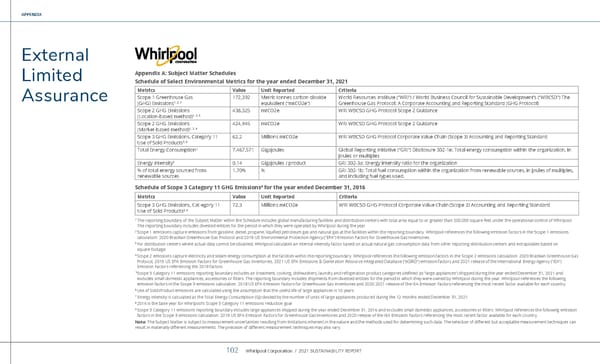
APPENDIX / OUR ESG APPROACH APPENDIX External Limited Assurance Appendix A: Subject Matter Schedules Schedule of Select Environmental Metrics for the year ended December 31, 2021 Metrics Value Unit Reported Criteria Scope 1 Greenhouse Gas (GHG) Emissions 1, 2, 3 172,392 Metric tonnes carbon dioxide equivalent (“mtCO2e”) World Resources Institute (“WRI”) / World Business Council for Sustainable Development’s (“WBCSD”) The Greenhouse Gas Protocol: A Corporate Accounting and Reporting Standard (GHG Protocol) Scope 2 GHG Emissions (Location-based method) 1, 3, 4 438,325 mtCO2e WRI WBCSD GHG Protocol Scope 2 Guidance Scope 2 GHG Emissions (Market-based method) 1, 3, 4 424,945 mtCO2e WRI WBCSD GHG Protocol Scope 2 Guidance Scope 3 GHG Emissions, Category 11 Use of Sold Products 5, 6 62.2 Millions mtCO2e WRI WBCSD GHG Protocol Corporate Value Chain (Scope 3) Accounting and Reporting Standard Total Energy Consumption 1 7,467,571 Gigajoules Global Reporting Initiative (“GRI”) Disclosure 302-1e: Total energy consumption within the organization, in joules or multiples Energy Intensity 7 0.14 Gigajoules / product GRI 302-3a: Energy intensity ratio for the organization % of total energy sourced from renewable sources 1.70% % GRI 302-1b: Total fuel consumption within the organization from renewable sources, in joules of multiples, and including fuel types used. Schedule of Scope 3 Category 11 GHG Emissions 8 for the year ended December 31, 2016 Metrics Value Unit Reported Criteria Scope 3 GHG Emissions, Cat-egory 11 Use of Sold Products 6, 9 72.3 Millions mtCO2e WRI WBCSD GHG Protocol Corporate Value Chain (Scope 3) Accounting and Reporting Standard 1 The reporting boundary of the Subject Matter within the Schedule includes globa l manufacturing facilities and distribution centers with total area equal to or greater than 500,000 square feet under the operational control of Whirlpool. The reporting boundary includes divested entities for the period in which they were operated by Whirlpool during the year. 2 Scope 1 emissions capture emissions from gasoline, diesel, propane, liquified pet roleum gas and natural gas at the facilities within the reporting boundary. Whirlpool references the following emission factors in the Scope 1 emissions calculation: 2020 Brazilian Greenhouse Gas Protocol and 2019 US Environmental Protection Agency (“EPA”) Emission Factors for Greenhouse Gas Inventories. 3 For distribution centers where actual data cannot be obtained, Whirlpool calculates an internal intensity factor based on actual natural gas consumption data from other reporting distribution centers and extrapolates based on square footage. 4 Scope 2 emissions capture electricity and steam energy consumption at the facili ties within the reporting boundary. Whirlpool references the following emission factors in the Scope 2 emissions calculation: 2020 Brazilian Greenhouse Gas Protocol, 2019 US EPA Emission Factors for Greenhouse Gas Inventories, 2021 US EPA Emissions & Generation Resource Integrated Database (“eGRID”) emission factors and 2021 release of the International Energy Agency (“IEA”) Emission Factors referencing the 2019 factors. 5 Scope 3 Category 11 emissions reporting boundary includes air treatment, cookin g, dishwashers, laundry and refrigeration product categories (defined as “large appliances”) shipped during the year ended December 31, 2021 and excludes small domestic appliances, accessories or filters. The reporting boundary includes shipments from divested entities for the period in which they were owned by Whirlpool during the year. Whirlpool references the following emission factors in the Scope 3 emissions calculation: 2018 US EPA Emission Factors for Greenhouse Gas Inventories and 2020 2021 release of the IEA Emission Factors referencing the most recent factor available for each country. 6 Use of Sold Product emissions are calculated using the assumption that the useful life of large appliances is 10 years. 7 Energy intensity is calculated as the Total Energy Consumption (GJ) divided by the number of units of large appliances produced during the 12 months ended December 31, 2021. 8 2016 is the base year for Whirlpool’s Scope 3 Category 11 emissions reduction go al 9 Scope 3 Category 11 emissions reporting boundary includes large appliances shipped during the year ended December 31, 2016 and excludes small domestic appliances, accessories or filters. Whirlpool references the following emission factors in the Scope 3 emissions calculation: 2018 US EPA Emission Factors for Greenhouse Gas Inventories and 2020 release of the IEA Emission Factors referencing the most recent factor available for each country. Note: The Subject Matter is subject to measurement uncertainties resulting from limitations inherent in the nature and the methods used for determining such data. The selection of different but acceptable measurement techniques can result in materially different measurements. The precision of different measurement techniques may also vary. Whirlpool Corporation / 2021 SUSTAINABILITY REPORT 102 Whirlpool Corporation / 2021 SUSTAINABILITY REPORT 102 Whirlpool Corporation / 2021 SUSTAINABILITY REPORT 102
 Whirlpool Sustainability Report Page 101 Page 103