

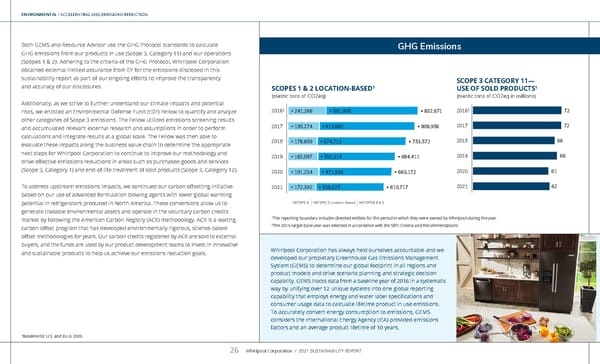
ENVIRONMENTAL / OUR ESG APPROACH ENVIRONMENTAL / ACCELERATING GHG EMISSIONS REDUCTION Both GEMS and Resource Advisor use the GHG Protocol standards to calculate GHG emissions from our products in use (Scope 3, Category 11) and our operations (Scopes 1 & 2). Adhering to the criteria of the GHG Protocol, Whirlpool Corporation obtained external limited assurance from EY for the emissions disclosed in this sustainability report as part of our ongoing efforts to improve the transparency and accuracy of our disclosures. Additionally, as we strive to further understand our climate impacts and potential risks, we enlisted an Environmental Defense Fund (EDF) Fellow to quantify and analyze other categories of Scope 3 emissions. The Fellow utilized emissions screening results and accumulated relevant external research and assumptions in order to perform calculations and integrate results at a global scale. The Fellow was then able to evaluate these impacts along the business value chain to determine the appropriate next steps for Whirlpool Corporation to continue to improve our methodology and drive effective emissions reductions in areas such as purchased goods and services (Scope 3, Category 1) and end-of-life treatment of sold products (Scope 3, Category 12). To address upstream emissions impacts, we continued our carbon offsetting initiative based on our use of advanced formulation blowing agents with lower global warming potential in refrigerators produced in North America. These conversions allow us to generate tradable environmental assets and operate in the voluntary carbon credits market by following the American Carbon Registry (ACR) methodology. ACR is a leading carbon offset program that has developed environmentally rigorous, science-based offset methodologies for years. Our carbon credits registered by ACR are sold to external buyers, and the funds are used by our product development teams to invest in innovative and sustainable products to help us achieve our emissions reduction goals. Whirlpool Corporation has always held ourselves accountable and we developed our propietary Greenhouse Gas Emissions Management System (GEMS) to determine our global footprint in all regions and product models and drive scenario planning and strategic decision capability. GEMS tracks data from a baseline year of 2016 in a systematic way by unifying over 12 unique systems into one global reporting capability that employs energy and water label specifications and consumer usage data to calculate lifetime product in use emissions. To accurately convert energy consumption to emissions, GEMS considers the International Energy Agency (IEA)-provided emissions factors and an average product lifetime of 10 years. SCOPES 1 & 2 LOCATION-BASED 1 (metric tons of CO2eq) 2017 2019 2018 2020 2021 2016 2 241,266 191,234 182,097 178,859 195,274 172,392 591,405 438,325 471,938 502,314 574,713 613,682 832,671 663,172 684,411 753,572 808,956 610,717 SCOPE 1 SCOPE 2 Location-Based SCOPES 1 & 2 SCOPE 3 CATEGORY 11— USE OF SOLD PRODUCTS 1 (metric tons of CO2eq in millions) 2019 68 2018 66 2020 61 2021 62 2017 72 2016 2 72 GHG Emissions 1 Baseline for U.S. and EU is 2005 1 The reporting boundary includes divested entities for the period in which they we re owned by Whirlpool during the year. 2 The 2016 target base year was selected in accordance with the SBTi Criteria and Recommendations Whirlpool Corporation / 2021 SUSTAINABILITY REPORT 26 Whirlpool Corporation / 2021 SUSTAINABILITY REPORT 26
 Whirlpool Sustainability Report Page 25 Page 27