

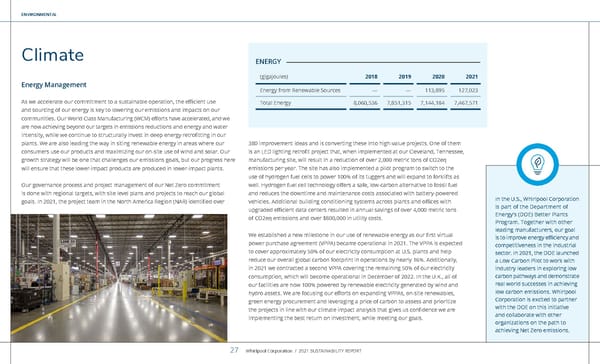
ENVIRONMENTAL / OUR ESG APPROACH ENVIRONMENTAL Climate Energy Management As we accelerate our commitment to a sustainable operation, the efficient use and sourcing of our energy is key to lowering our emissions and impacts on our communities. Our World Class Manufacturing (WCM) efforts have accelerated, and we are now achieving beyond our targets in emissions reductions and energy and water intensity, while we continue to structurally invest in deep energy retrofitting in our plants. We are also leading the way in siting renewable energy in areas where our consumers use our products and maximizing our on-site use of wind and solar. Our growth strategy will be one that challenges our emissions goals, but our progress here will ensure that these lower-impact products are produced in lower-impact plants. Our governance process and project management of our Net Zero commitment is done with regional targets, with site level plans and projects to reach our global goals. In 2021, the project team in the North America Region (NAR) identified over 380 improvement ideas and is converting these into high-value projects. One of them is an LED lighting retrofit project that, when implemented at our Cleveland, Tennessee, manufacturing site, will result in a reduction of over 2,000 metric tons of CO2eq emissions per year. The site has also implemented a pilot program to switch to the use of hydrogen fuel cells to power 100% of its tuggers and will expand to forklifts as well. Hydrogen fuel cell technology offers a safe, low-carbon alternative to fossil fuel and reduces the downtime and maintenance costs associated with battery-powered vehicles. Additional building conditioning systems across plants and offices with upgraded efficient data centers resulted in annual savings of over 4,000 metric tons of CO2eq emissions and over $800,000 in utility costs. We established a new milestone in our use of renewable energy as our first virtual power purchase agreement (VPPA) became operational in 2021. The VPPA is expected to cover approximately 50% of our electricity consumption at U.S. plants and help reduce our overall global carbon footprint in operations by nearly 16%. Additionally, in 2021 we contracted a second VPPA covering the remaining 50% of our electricity consumption, which will become operational in December of 2022. In the U.K., all of our facilities are now 100% powered by renewable electricity generated by wind and hydro assets. We are focusing our efforts on expanding VPPAs, on-site renewables, green energy procurement and leveraging a price of carbon to assess and prioritize the projects in line with our climate impact analysis that gives us confidence we are implementing the best return on investment, while meeting our goals. In the U.S., Whirlpool Corporation is part of the Department of Energy’s (DOE) Better Plants Program. Together with other leading manufacturers, our goal is to improve energy efficiency and competitiveness in the industrial sector. In 2021, the DOE launched a Low Carbon Pilot to work with industry leaders in exploring low carbon pathways and demonstrate real world successes in achieving low carbon emissions. Whirlpool Corporation is excited to partner with the DOE on this initiative and collaborate with other organizations on the path to achieving Net Zero emissions. (gigajoules) 2018 2019 2020 2021 Energy from Renewable Sources — — 113,895 127,023 Total Energy 8,060,536 7,851,315 7,144,184 7,467,571 ENERGY Whirlpool Corporation / 2021 SUSTAINABILITY REPORT 27 Whirlpool Corporation / 2021 SUSTAINABILITY REPORT 27
 Whirlpool Sustainability Report Page 26 Page 28