

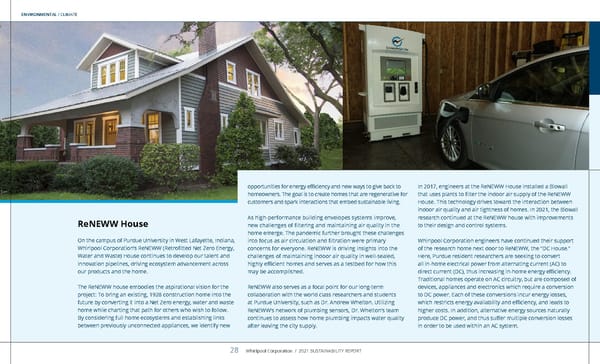
ENVIRONMENTAL / OUR ESG APPROACH ReNEWW House On the campus of Purdue University in West Lafayette, Indiana, Whirlpool Corporation’s ReNEWW (Retrofitted Net Zero Energy, Water and Waste) House continues to develop our talent and innovation pipelines, driving ecosystem advancement across our products and the home. The ReNEWW house embodies the aspirational vision for the project: To bring an existing, 1928 construction home into the future by converting it into a Net Zero energy, water and waste home while charting that path for others who wish to follow. By considering full home ecosystems and establishing links between previously unconnected appliances, we identify new opportunities for energy efficiency and new ways to give back to homeowners. The goal is to create homes that are regenerative for customers and spark interactions that embed sustainable living. As high-performance building envelopes systems improve, new challenges of filtering and maintaining air quality in the home emerge. The pandemic further brought these challenges into focus as air circulation and filtration were primary concerns for everyone. ReNEWW is driving insights into the challenges of maintaining indoor air quality in well-sealed, highly efficient homes and serves as a testbed for how this may be accomplished. ReNEWW also serves as a focal point for our long-term collaboration with the world class researchers and students at Purdue University, such as Dr. Andrew Whelton. Utilizing ReNEWW’s network of plumbing sensors, Dr. Whelton’s team continues to assess how home plumbing impacts water quality after leaving the city supply. In 2017, engineers at the ReNEWW House installed a Biowall that uses plants to filter the indoor air supply of the ReNEWW House. This technology drives toward the interaction between indoor air quality and air tightness of homes. In 2021, the Biowall research continued at the ReNEWW house with improvements to their design and control systems. Whirlpool Corporation engineers have continued their support of the research home next door to ReNEWW, the “DC House.” Here, Purdue resident researchers are seeking to convert all in-home electrical power from alternating current (AC) to direct current (DC), thus increasing in-home energy efficiency. Traditional homes operate on AC circuitry, but are composed of devices, appliances and electronics which require a conversion to DC power. Each of these conversions incur energy losses, which restricts energy availability and efficiency, and leads to higher costs. In addition, alternative energy sources naturally produce DC power, and thus suffer multiple conversion losses in order to be used within an AC system. ENVIRONMENTAL / CLIMATE Whirlpool Corporation / 2021 SUSTAINABILITY REPORT 28 Whirlpool Corporation / 2021 SUSTAINABILITY REPORT 28
 Whirlpool Sustainability Report Page 27 Page 29