

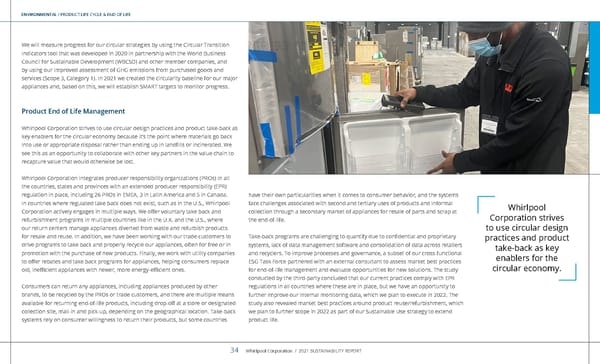
ENVIRONMENTAL / OUR ESG APPROACH ENVIRONMENTAL / PRODUCT LIFE CYCLE & END OF LIFE We will measure progress for our circular strategies by using the Circular Transition Indicators tool that was developed in 2020 in partnership with the World Business Council for Sustainable Development (WBCSD) and other member companies, and by using our improved assessment of GHG emissions from purchased goods and services (Scope 3, Category 1). In 2021 we created the circularity baseline for our major appliances and, based on this, we will establish SMART targets to monitor progress. Product End of Life Management Whirlpool Corporation strives to use circular design practices and product take-back as key enablers for the circular economy because it’s the point where materials go back into use or appropriate disposal rather than ending up in landfills or incinerated. We see this as an opportunity to collaborate with other key partners in the value chain to recapture value that would otherwise be lost. Whirlpool Corporation integrates producer responsibility organizations (PROs) in all the countries, states and provinces with an extended producer responsibility (EPR) regulation in place, including 26 PROs in EMEA, 3 in Latin America and 5 in Canada. In countries where regulated take back does not exist, such as in the U.S., Whirlpool Corporation actively engages in multiple ways. We offer voluntary take back and refurbishment programs in multiple countries like in the U.K. and the U.S., where our return centers manage appliances diverted from waste and refurbish products for resale and reuse. In addition, we have been working with our trade customers to drive programs to take back and properly recycle our appliances, often for free or in promotion with the purchase of new products. Finally, we work with utility companies to offer rebates and take back programs for appliances, helping consumers replace old, inefficient appliances with newer, more energy-efficient ones. Consumers can return any appliances, including appliances produced by other brands, to be recycled by the PROs or trade customers, and there are multiple means available for returning end-of-life products, including drop-off at a store or designated collection site, mail-in and pick-up, depending on the geographical location. Take-back systems rely on consumer willingness to return their products, but some countries have their own particularities when it comes to consumer behavior, and the systems face challenges associated with second and tertiary uses of products and informal collection through a secondary market of appliances for resale of parts and scrap at the end-of-life. Take-back programs are challenging to quantify due to confidential and proprietary systems, lack of data management software and consolidation of data across retailers and recyclers. To improve processes and governance, a subset of our cross-functional ESG Task Force partnered with an external consultant to assess market best practices for end-of-life management and evaluate opportunities for new solutions. The study conducted by the third-party concluded that our current practices comply with EPR regulations in all countries where these are in place, but we have an opportunity to further improve our internal monitoring data, which we plan to execute in 2022. The study also revealed market best practices around product reuse/refurbishment, which we plan to further scope in 2022 as part of our Sustainable Use strategy to extend product life. Whirlpool Corporation strives to use circular design practices and product take-back as key enablers for the circular economy. Whirlpool Corporation / 2021 SUSTAINABILITY REPORT 34 Whirlpool Corporation / 2021 SUSTAINABILITY REPORT 34
 Whirlpool Sustainability Report Page 33 Page 35