

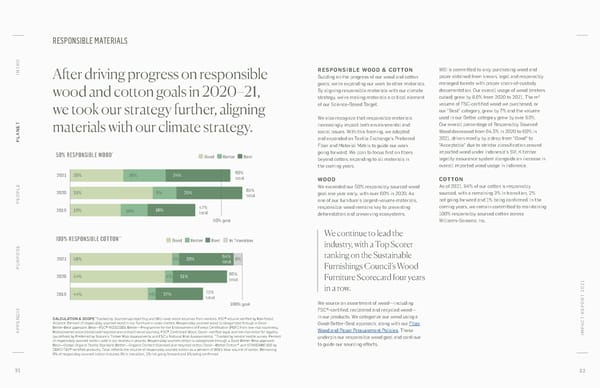
RESPONSIBLE MATERIALS O INTR RESPONSIBLE WOOD & COTTON WSI is committed to only purchasing wood and After driving progress on responsible Building on the progress of our wood and cotton paper obtained from known, legal and responsibly goals, we’re expanding our work to other materials. managed forests with proper chain-of-custody wood and cotton goals in 2020–21, By aligning responsible materials with our climate documentation. Our overall usage of wood (meters 3 strategy, we’re making materials a critical element cubed) grew by 8.6% from 2020 to 2021. The m of our Science-Based Target. volume of FSC-certified wood we purchased, or we took our strategy further, aligning our “Best” category, grew by 7% and the volume We also recognize that responsible materials used in our Better category grew by over 93%. materials with our climate strategy. increasingly impact both environmental and Our overall percentage of Responsibly Sourced ANET social issues. With this framing, we adopted Wood decreased from 64.5% in 2020 to 60% in PL and expanded on Textile Exchange’s Preferred 2021, driven mostly by a drop from “Good” to Fiber and Material Matrix to guide our work “Acceptable” due to stricter classification around 50% RESPONSIBLE WOOD* Good Better Best going forward. We plan to focus first on fibers imported wood under Indonesia’s SVLK timber beyond cotton, expanding to all materials in legality assurance system alongside an increase in the coming years. overall imported wood usage in Indonesia. 2021 20% 16% 24% 60% total WOOD COTTON 65% We exceeded our 50% responsibly sourced wood As of 2021, 94% of our cotton is responsibly OPLE 2020 31% 9% 25% total goal one year early, with over 60% in 2020. As sourced, with a remaining 3% in transition, 2% PE one of our furniture’s largest-volume materials, not going forward and 1% being confirmed. In the 2019 19% 10% 18% 47% responsible wood remains key to preventing coming years, we remain committed to maintaining total deforestation and preserving ecosystems. 100% responsibly sourced cotton across 50% goal Williams-Sonoma, Inc. ** We continue to lead the 100% RESPONSIBLE COTTON Good Better Best In Transition industry, with a Top Scorer 2021 58% 3% 33% 94% 6% ranking on the Sustainable PURPOSE total Furnishings Council’s Wood 2020 54% 4% 31% 89% Furniture Scorecard four years total 75% in a row. 2019 44% 4% 27% total T 2021 100% goal We source an assortment of wood—including FSC®-certified, reclaimed and recycled wood— * in our products. We categorize our wood using a T REPOR CALCULATION & SCOPE Tracked by Sourcemap reporting and SKU-level wood volumes from vendors. FSC® volume verified by Rainforest C Alliance. Percent of responsibly sourced wood in our furniture in cubic meters. Responsibly sourced wood is categorized through a Good- Good-Better-Best approach, along with our Fiber, A Better-Best approach: Best—FSC®-N0002185; Better—Programme for the Endorsement of Forest Certification (PEFC from low-risk countries), Wood and Paper Procurement Policies. These APPENDIX Rediscovered wood (reclaimed/recycled and orchard wood sources), FSC® Controlled Wood; Good—verified legal and low-risk wood for legality IMP ** (as defined by Preferred by Nature’s Timber Risk Assessments and FSC’s National Risk Assessments). Tracked by vendor textile survey. Percent underpin our responsible wood goal and continue of responsibly sourced cotton used in our textiles in pounds. Responsibly sourced cotton is categorized through a Good-Better-Best approach: to guide our sourcing efforts. Best—Global Organic Textile Standard; Better—Organic Content Standard and recycled cotton; Good—Better Cotton™ and STANDARD 100 by OEKO-TEX® certified products. Total reflects the volume of responsibly sourced cotton as a percent of WSI’s total volume of cotton. Remaining 6% of responsibly sourced cotton includes 3% in transition, 2% not going forward and 1% being confirmed. 31 32
 Williams-Sonoma, Inc - Impact Report Page 15 Page 17