

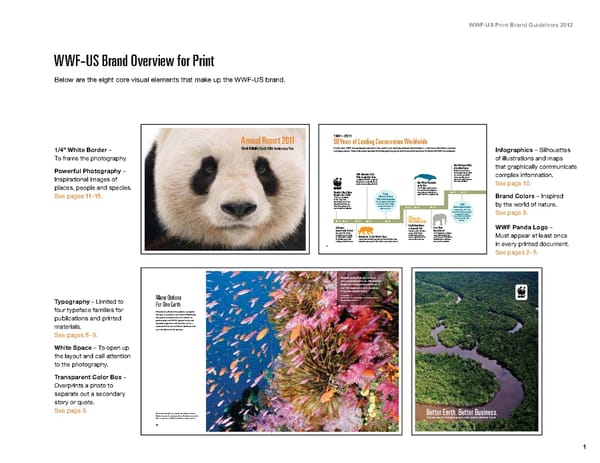
WWF-US Print Brand Guidelines 2012 WWF-US Brand Overview for Print Below are the eight core visual elements that make up the WWF-US brand. Annual Report 2011 1961–2011 50 Years of Leading Conservation Worldwide World Wildlife Fund’s 50th Anniversary Year For 50 years, WWF has developed solutions to the world’s most pressing environmental problems—and those innovations continue 1/4” White Border – to produce results. These milestones represent both inaugural successes and the powerful advances for nature that WWF has achieved. Infographics – Silhouettes To frame the photography. of illustrations and maps 564,000 Square Miles that graphically communicate of Certified Forest Powerful Photography – Helped create the Forest 90% Reduction in U.S. Stewardship Council, which has certified sustainable complex information. Wild-Caught Bird Trade forests covering an area Inspirational images of Established TRAFFIC to fight the larger than Spain, Morocco illegal trade of wild animals and Blue Whale Population and Japan combined. plants in partnership with IUCN. on the Rise See page 10. places, people and species. WWF helped achieve world’s first commercial whaling ban, Namibia’s Black Rhino Panda and continues to fight threats 1993 1994 See pages 11–15. Numbers Up 1,300% Reserves Protect against whales at a global scale. Brand Colors – Inspired WWF was established 70% of the Population in 1961. Since then, international efforts have First environmental nonprofit brought black rhinos and invited into China. Helped 1,400 by the world of nature. many other species back develop a network of 62 1984 1986 1989 Conservation Leaders from the brink of extinction. protected areas. Launched Russell E. Train Education for Nature program to support in-country See page 6. conservation leadership in $1 BILLIoN+ Africa, Asia and Latin 1961 1962 1973 1976 1980 FoR CoNSERvATIoN America. Galápagos Establishing Nature Ivory Trade Conservation Evolves as Economic Tool Ban Achieved WWF Panda Logo – Conceived debt-for-nature Invested in the Charles swaps, which forgive WWF-supported campaign Darwin Research Station. Habitats for 1/2 the World’s Tigers national debt to protect closed international ivory Must appear at least once In 1998, helped establish nature, a global model for trade; between 470,000 and the 50,000-square-mile Worked with the Indian government to launch Project Tiger, conservation to this day. 690,000 African elephants Galápagos Marine Reserve. laying the groundwork for all of India’s current tiger reserves. now roam the continent. in every printed document. C1 22 See pages 2–5. “ Sustainability has got to be a pre-competitive issue. We need to begin to manage this planet as if our life depended on it, because it fundamentally does.” Jason Clay Many Options Senior Vice President, Market Transformation Typography – Limited to For One Earth World Wildlife Fund four typeface families for Whichever collaborative option a company chooses, it can play a key role in influencing publications and printed the course of conservation. Its efforts, in partnership with WWF’s global reach and scientific expertise, will lead the way in a materials. movement that can transform business and save our planet in the process. See pages 8–9. White Space – To open up the layout and call attention to the photography. Transparent Color Box – Overprints a photo to separate out a secondary story or quote. See page 9. The Coral Triangle is one of the most diverse marine Better Earth. Better Business. habitats on Earth, teeming with an abundance of corals, Conservation Collaborations with World Wildlife Fund fish, crustaceans, mollusks and marine plant species. 18 1
 WWF Brand Book Page 2 Page 4