

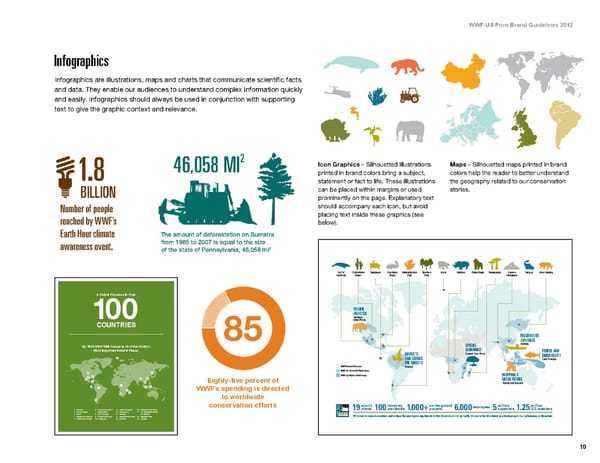
WWF-US Print Brand Guidelines 2012 Infographics Infographics are illustrations, maps and charts that communicate scientific facts and data. They enable our audiences to understand complex information quickly and easily. Infographics should always be used in conjunction with supporting text to give the graphic context and relevance. 46,058 MI2 Icon Graphics – Silhouetted illustrations Maps – Silhouetted maps printed in brand 1.8 printed in brand colors bring a subject, colors help the reader to better understand statement or fact to life. These illustrations the geography related to our conservation BILLION can be placed within margins or used stories. prominently on the page. Explanatory text Number of people should accompany each icon, but avoid reached by WWF’s placing text inside these graphics (see below). Earth Hour climate The amount of deforestation on Sumatra from 1985 to 2007 is equal to the size awareness event. of the state of Pennsylvania, 46,058 mi2 Gulf of Chihuahuan Galápagos Southeast Mesoamerican Southern Arctic Namibia Congo Basin Madagascar Eastern Yangtze Amur-Heilong California Desert Rivers Reef Chile Himalayas A Global Presence in Over PRAIRIE ANALYSIS 100 Northern COUNTRIES Great Plains 85 fRESHWAtER ADVANCES By 2020 WWF Will Conserve 19 of the World’s SPECIES Mekong Most Important Natural Places ECONOMICS PEOPLE AND MARkEtS Coastal East Africa BIODIVERSItY 3 AND SCIENCE Coral Triangle fOR fOREStS WWF Network Presence Amazon WWF-US Terrestrial Priority Areas 16 2 17 WWF-US Marine Priority Areas MAPPINg A 5 9 19 11 gREEN futuRE 14 13 Eighty-five percent of Borneo and Sumatra 10 7 4 8 1 6 WWF’s spending is directed 15 12 to worldwide 18 conservation efforts priority countries 1,000+on-the-ground 6,000employees 5million million 1. Amazon 6. Coastal East Africa 11. Gulf of California 16. Northern Great Plains 19places 100 worldwide projects supporters 1. 25 U.S. members 2. Amur-Heilong 7. Congo Basin 12. Madagascar 17. U.S. Southeast Rivers 3. Arctic 8. Coral Triangle 13. Mekong and Streams Mission: to conserve nature and reduce the most pressing threats to the diversity of life on Earth. Vision: to build a future in which people live in harmony with nature. 4. Borneo and Sumatra 9. Eastern Himalayas 14. Mesoamerican Reef 18. Southern Chile 5. Chihuahuan Desert 10. Galápagos 15. Namibia 19. Yangtze 2 10
 WWF Brand Book Page 11 Page 13