

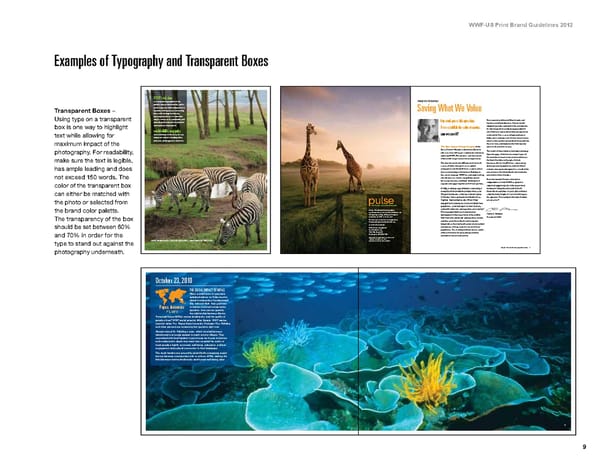
WWF-US Print Brand Guidelines 2012 Examples of Typography and Transparent Boxes ’ WWFs mission is to stop the degradation of the FROM THE PRESIDENT planet’s natural environment, and to build a future in which humans live in Transparent Boxes – harmony with nature, by conserving Saving What We Value the world’s biological diversity, ensuring that the use of renewable Using type on a transparent natural resources is sustainable, and Our work poses this question: More innovation followed. When friends and promoting the reduction of pollution family visited Owen-Smith in Namibia he felt box is one way to highlight and wasteful consumption. If we establish the value of nature, obliged to provide a payment to the communities worldwildlife.org/pulse for their hospitality, establishing precedent for Get to the heart of the story. Access can we save it? one of the most successful ecotourism operations text while allowing for in the world. Now, a series of high-end tourist enhanced content including video, lodges share revenues with 57 local conservancies, podcasts, photo galleries and more. © WWF-US which in turn protect not just black rhinos but also maximum impact of the the oryx, lions and elephants that have become This May I passed through the gates of the such an attraction for visitors. Swiss National Museum in downtown Zurich to The results of these ventures have been stunning. —a multimedia exhibition photography. For readability, take in its latest offering Open the pages of the latest bi-annual report of exploring WWF’s first 50 years, and the creation the community conservancy system and you see make sure the text is legible, of the world’s largest conservation organization. the kind of hockey-stick graphs of which The show chronicles the defining act of our birth: businesses dream: long flat lines, representing a series of letters that gave rise to a global declining animal populations and lack of local has ample leading and does campaign to save the black rhino, a species whose revenue, turning sharply upward as a result of the very existence hung in the balance. Building on conservancies that Owen-Smith and Jacobsohn this initial campaign, WWF has continued working conceived with local leaders. not exceed 150 words. The over the years to save this magnificent animal From the moment Namibia achieved its by raising awareness and funds, building local independence in 1990, WWF has played an color of the transparent box capacity and supporting the work of local partners. important supporting role in the conservancy In 1983 an enterprising adventurer and ecologist movement, taking the early work of Garth named Garth Owen-Smith worked with his wife, Owen-Smith and others to scale. Our work here can either be matched with Margaret Jacobsohn, in the most remote regions is but the latest chapter of a narrative that poses of Namibia, then a protectorate of South Africa. this question: If we establish the value of nature, Together, they hatched an idea: What if they can we save it? the photo or selected from pulse engaged local communities to monitor black rhino the heart of conservation populations, scout and report on their locations, the brand color palette. Pulse: The Heart of Conservation and notify authorities when poachers were nearby? is published twice a year by World Wildlife Fund. If local people linked social and economic All reporting, writing, editing and design is development to the conservation of the wildlife Carter S. Roberts created by our WWF in-house staff. they lived with side by side, perhaps these animals President & CEO The transparency of the box We value your comments and suggestions. could be saved. Owen-Smith and Jacobsohn Please send email to pulse@wwfus.org or write to this address: helped devise the event book system which enabled should be set between 60% Pulse, Donor Engagement communities to keep accurate records of rhino World Wildlife Fund populations. This tracking method remains a pillar 1250 24th Street, NW of the extraordinarily successful present-day and 70% in order for the Washington, DC 20037-1193 community conservancy system. CoveR phoTo: © anup Shah / naTuRepl.CoM World Wildlife Fund / 1250 24th Street, NW / Washington, DC 20037-1193 ThIS page: © Manuel guTjahR type to stand out against the baCk CoveR: © ChRISTophe CeRISIeR FPO 2 WORLDWILDLIFE.ORG/PULSE PULSE: THE HEART OF CONSERVATION 1 photography underneath. october 23, 2010 The Social impacT of mpaS When a small team of scientists splashed ashore on Pulau Numfor Island in Indonesia’s Cenderawasih Bay National Park, their goal was papua, indonesia to answer a central conservation 1° S, 135° e question: How can we quantify the relationship between Marine Protected Areas (MPAs), marine biodiversity, and the quality of people’s lives? WWF social scientist Mike Mascia, WWF marine scientist Helen Fox, Papua State University Professor Fitry Pakiding and other partners are answering that question right now. Mascia trained Dr. Pakiding’s team, which traveled between islands and over jungle passes to reach remote villages. They negotiated with local leaders to gain house-by-house invitations, and conducted in-depth interviews that revealed the reality of local people’s health, economic well-being, education, political engagement and cultural connection to their landscape. The study breaks new ground by scientifically comparing social factors between communities with or without MPAs, making the links between marine biodiversity and human well-being clear. 11 9
 WWF Brand Book Page 10 Page 12