

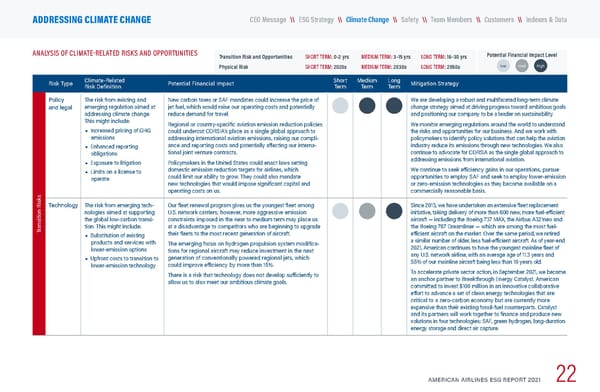
ANALYSIS OF CLIMATE-RELATED RISKS AND OPPORTUNITIES Risk Type Climate-Related Risk Definition Potential Financial Impact Short Term Medium Term Long Term Mitigation Strategy Transition Risks Policy and legal The risk from existing and emerging regulation aimed at addressing climate change. This might include: • Increased pricing of GHG emissions • Enhanced reporting obligations • Exposure to litigation • Limits on a license to operate New carbon taxes or SAF mandates could increase the price of jet fuel, which would raise our operating costs and potentially reduce demand for travel. Regional or country-specific aviation emission reduction policies could undercut CORSIA’s place as a single global approach to addressing international aviation emissions, raising our compli - ance and reporting costs and potentially affecting our interna - tional joint venture contracts. Policymakers in the United States could enact laws setting domestic emission reduction targets for airlines, which could limit our ability to grow. They could also mandate new technologies that would impose significant capital and operating costs on us. We are developing a robust and multifaceted long-term climate change strategy aimed at driving progress toward ambitious goals and positioning our company to be a leader on sustainability. We monitor emerging regulations around the world to understand the risks and opportunities for our business. And we work with policymakers to identify policy solutions that can help the aviation industry reduce its emissions through new technologies. We also continue to advocate for CORSIA as the single global approach to addressing emissions from international aviation. We continue to seek efficiency gains in our operations, pursue opportunities to employ SAF and seek to employ lower-emission or zero-emission technologies as they become available on a commercially reasonable basis. Technology The risk from emerging tech - nologies aimed at supporting the global low-carbon transi - tion. This might include: • Substitution of existing products and services with lower-emission options • Upfront costs to transition to lower-emission technology Our fleet renewal program gives us the youngest fleet among U.S. network carriers; however, more aggressive emission constraints imposed in the near to medium term may place us at a disadvantage to competitors who are beginning to upgrade their fleets to the most recent generation of aircraft. The emerging focus on hydrogen propulsion system modifica - tions for regional aircraft may reduce investment in the next generation of conventionally powered regional jets, which could improve efficiency by more than 15%. There is a risk that technology does not develop sufficiently to allow us to also meet our ambitious climate goals. Since 2013, we have undertaken an extensive fleet replacement initiative, taking delivery of more than 600 new, more fuel-efficient aircraft — including the Boeing 737 MAX, the Airbus A321neo and the Boeing 787 Dreamliner — which are among the most fuel- efficient aircraft on the market. Over the same period, we retired a similar number of older, less fuel-efficient aircraft. As of year-end 2021, American continues to have the youngest mainline fleet of any U.S. network airline, with an average age of 11.3 years and 55% of our mainline aircraft being less than 10 years old. To accelerate private sector action, in September 2021, we became an anchor partner to Breakthrough Energy Catalyst. American committed to invest $100 million in an innovative collaborative effort to advance a set of clean energy technologies that are critical to a zero-carbon economy but are currently more expensive than their existing fossil-fuel counterparts. Catalyst and its partners will work together to finance and produce new solutions in four technologies: SAF, green hydrogen, long-duration energy storage and direct air capture. Transition Risk and Opportunities SHORT TERM: 0–2 yrs MEDIUM TERM: 3–15 yrs LONG TERM: 16–30 yrs Potential Financial Impact Level Physical Risk SHORT TERM: 2020s MEDIUM TERM: 2030s LONG TERM: 2050s low med high AMERICAN AIRLINES ESG REPORT 2021 22 \\ Indexes & Data \\ Customers \\ Team Members \\ Safety \\ ESG Strategy CEO Message ADDRESSING CLIMATE CHANGE \\ Climate Change
 American Airlines ESG Report Page 22 Page 24