

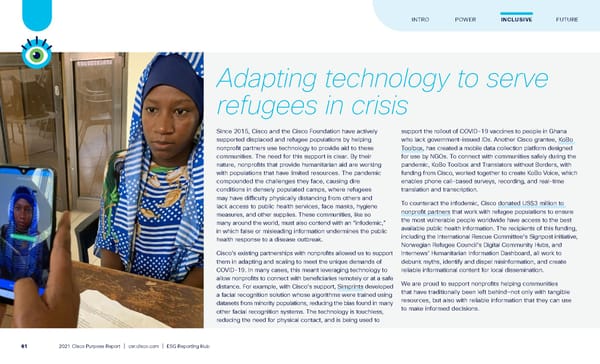
Adapting technology to serve refugees in crisis Since 2015, Cisco and the Cisco Foundation have actively supported displaced and refugee populations by helping nonprofit partners use technology to provide aid to these communities. The need for this support is clear. By their nature, nonprofits that provide humanitarian aid are working with populations that have limited resources. The pandemic compounded the challenges they face, causing dire conditions in densely populated camps, where refugees may have difficulty physically distancing from others and lack access to public health services, face masks, hygiene measures, and other supplies. These communities, like so many around the world, must also contend with an “infodemic,” in which false or misleading information undermines the public health response to a disease outbreak. Cisco’s existing partnerships with nonprofits allowed us to support them in adapting and scaling to meet the unique demands of COVID-19. In many cases, this meant leveraging technology to allow nonprofits to connect with beneficiaries remotely or at a safe distance. For example, with Cisco’s support, Simprints developed a facial recognition solution whose algorithms were trained using datasets from minority populations, reducing the bias found in many other facial recognition systems. The technology is touchless, reducing the need for physical contact, and is being used to support the rollout of COVID-19 vaccines to people in Ghana who lack government-issued IDs. Another Cisco grantee, KoBo Toolbox , has created a mobile data collection platform designed for use by NGOs. To connect with communities safely during the pandemic, KoBo Toolbox and Translators without Borders, with funding from Cisco, worked together to create KoBo Voice, which enables phone call-based surveys, recording, and real-time translation and transcription. To counteract the infodemic, Cisco donated US$3 million to nonprofit partners that work with refugee populations to ensure the most vulnerable people worldwide have access to the best available public health information. The recipients of this funding, including the International Rescue Committee’s Signpost initiative, Norwegian Refugee Council’s Digital Community Hubs, and Internews’ Humanitarian Information Dashboard, all work to debunk myths, identify and dispel misinformation, and create reliable informational content for local dissemination. We are proud to support nonprofits helping communities that have traditionally been left behind—not only with tangible resources, but also with reliable information that they can use to make informed decisions. FUTURE INTRO POWER INCLUSIVE 2021 Cisco Purpose Report | csr.cisco.com | ESG Reporting Hub 61
 Cisco Purpose Report Page 61 Page 63