

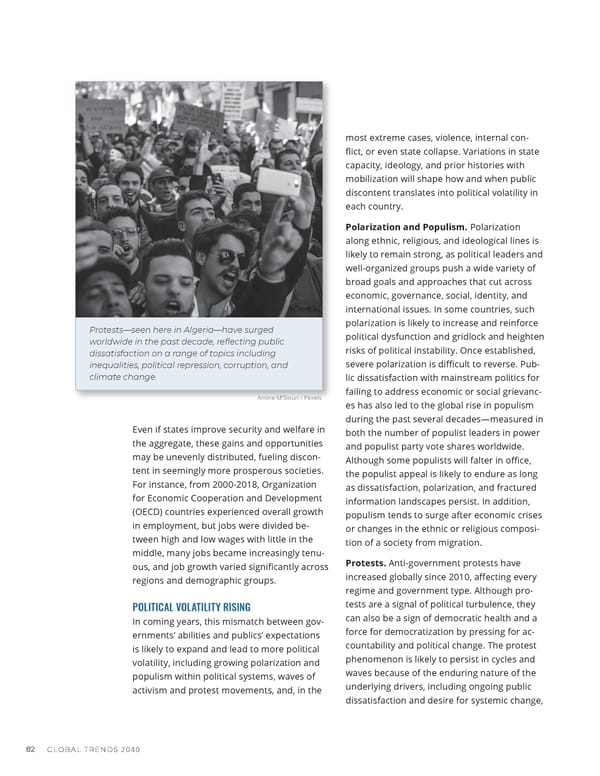
most extreme cases, violence, internal con- 昀氀ict, or even state collapse. Variations in state capacity, ideology, and prior histories with mobilization will shape how and when public discontent translates into political volatility in each country. Polarization and Populism. Polarization along ethnic, religious, and ideological lines is likely to remain strong, as political leaders and well-organized groups push a wide variety of broad goals and approaches that cut across economic, governance, social, identity, and international issues. In some countries, such Protests—seen here in Algeria—have surged polarization is likely to increase and reinforce political dysfunction and gridlock and heighten worldwide in the past decade, reflecting public risks of political instability. Once established, dissatisfaction on a range of topics including inequalities, political repression, corruption, and severe polarization is di昀케cult to reverse. Pub- climate change. lic dissatisfaction with mainstream politics for Amine M'Siouri / Pexels failing to address economic or social grievanc- es has also led to the global rise in populism during the past several decades—measured in Even if states improve security and welfare in both the number of populist leaders in power the aggregate, these gains and opportunities and populist party vote shares worldwide. may be unevenly distributed, fueling discon- Although some populists will falter in o昀케ce, tent in seemingly more prosperous societies. the populist appeal is likely to endure as long For instance, from 2000-2018, Organization as dissatisfaction, polarization, and fractured for Economic Cooperation and Development information landscapes persist. In addition, (OECD) countries experienced overall growth populism tends to surge after economic crises in employment, but jobs were divided be- or changes in the ethnic or religious composi- tween high and low wages with little in the tion of a society from migration. middle, many jobs became increasingly tenu- Protests. Anti-government protests have ous, and job growth varied signi昀椀cantly across regions and demographic groups. increased globally since 2010, a昀昀ecting every regime and government type. Although pro- POLITICAL VOLATILITY RISING tests are a signal of political turbulence, they In coming years, this mismatch between gov- can also be a sign of democratic health and a ernments’ abilities and publics’ expectations force for democratization by pressing for ac- is likely to expand and lead to more political countability and political change. The protest volatility, including growing polarization and phenomenon is likely to persist in cycles and populism within political systems, waves of waves because of the enduring nature of the activism and protest movements, and, in the underlying drivers, including ongoing public dissatisfaction and desire for systemic change, 82 GLOBAL TRENDS 2040
 GlobalTrends 2040 Page 89 Page 91