

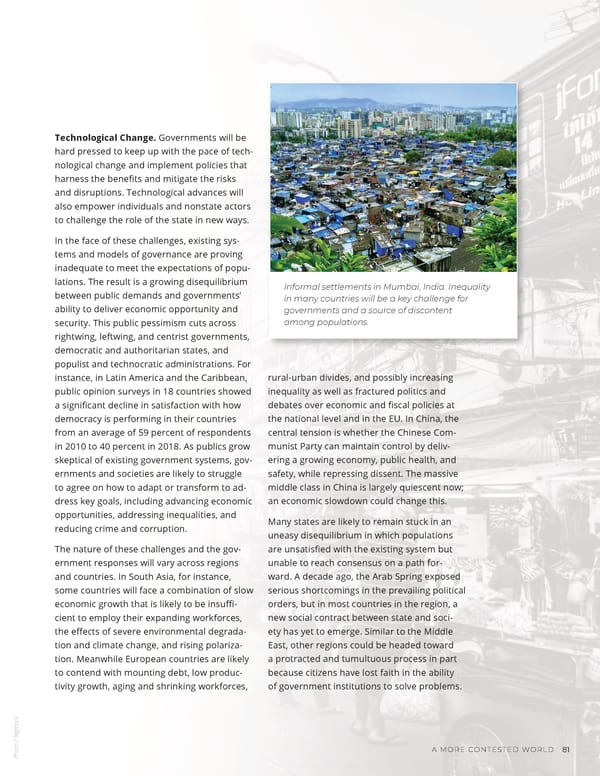
Technological Change. Governments will be hard pressed to keep up with the pace of tech- nological change and implement policies that harness the bene昀椀ts and mitigate the risks and disruptions. Technological advances will also empower individuals and nonstate actors to challenge the role of the state in new ways. In the face of these challenges, existing sys- tems and models of governance are proving inadequate to meet the expectations of popu- lations. The result is a growing disequilibrium Informal settlements in Mumbai, India. Inequality between public demands and governments’ in many countries will be a key challenge for ability to deliver economic opportunity and governments and a source of discontent security. This public pessimism cuts across among populations. rightwing, leftwing, and centrist governments, democratic and authoritarian states, and Alfarnas Solkar / Unsplash populist and technocratic administrations. For instance, in Latin America and the Caribbean, rural-urban divides, and possibly increasing public opinion surveys in 18 countries showed inequality as well as fractured politics and debates over economic and 昀椀scal policies at a signi昀椀cant decline in satisfaction with how democracy is performing in their countries the national level and in the EU. In China, the central tension is whether the Chinese Com- from an average of 59 percent of respondents in 2010 to 40 percent in 2018. As publics grow munist Party can maintain control by deliv- skeptical of existing government systems, gov- ering a growing economy, public health, and ernments and societies are likely to struggle safety, while repressing dissent. The massive to agree on how to adapt or transform to ad- middle class in China is largely quiescent now; dress key goals, including advancing economic an economic slowdown could change this. opportunities, addressing inequalities, and Many states are likely to remain stuck in an reducing crime and corruption. uneasy disequilibrium in which populations The nature of these challenges and the gov- are unsatis昀椀ed with the existing system but ernment responses will vary across regions unable to reach consensus on a path for- and countries. In South Asia, for instance, ward. A decade ago, the Arab Spring exposed some countries will face a combination of slow serious shortcomings in the prevailing political economic growth that is likely to be insu昀케- orders, but in most countries in the region, a cient to employ their expanding workforces, new social contract between state and soci- the e昀昀ects of severe environmental degrada- ety has yet to emerge. Similar to the Middle tion and climate change, and rising polariza- East, other regions could be headed toward tion. Meanwhile European countries are likely a protracted and tumultuous process in part to contend with mounting debt, low produc- because citizens have lost faith in the ability tivity growth, aging and shrinking workforces, of government institutions to solve problems. A MORE CONTESTED WORLD 81 Photo / Bigstock
 GlobalTrends 2040 Page 88 Page 90