

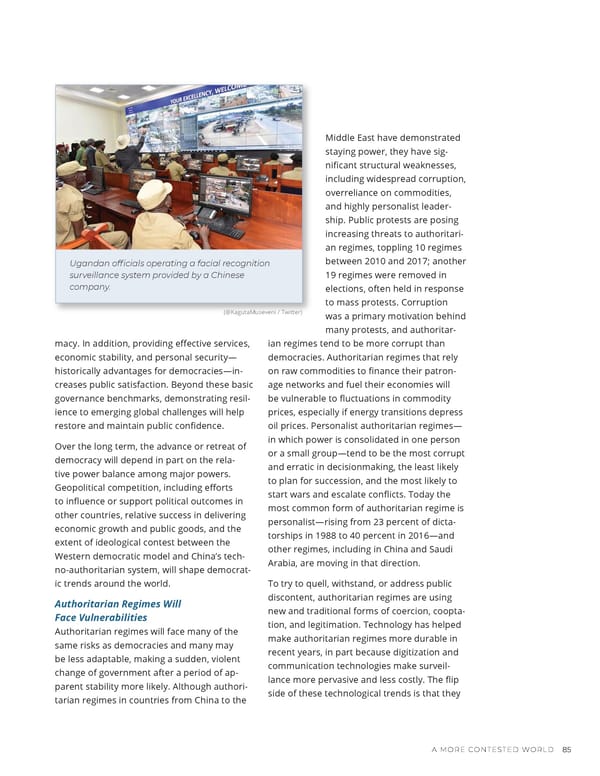
Middle East have demonstrated staying power, they have sig- ni昀椀cant structural weaknesses, including widespread corruption, overreliance on commodities, and highly personalist leader- ship. Public protests are posing increasing threats to authoritari- an regimes, toppling 10 regimes between 2010 and 2017; another Ugandan officials operating a facial recognition surveillance system provided by a Chinese 19 regimes were removed in company. elections, often held in response to mass protests. Corruption (@KagutaMuseveni / Twitter) was a primary motivation behind many protests, and authoritar- macy. In addition, providing e昀昀ective services, ian regimes tend to be more corrupt than economic stability, and personal security— democracies. Authoritarian regimes that rely historically advantages for democracies—in- on raw commodities to 昀椀nance their patron- creases public satisfaction. Beyond these basic age networks and fuel their economies will governance benchmarks, demonstrating resil- be vulnerable to 昀氀uctuations in commodity ience to emerging global challenges will help prices, especially if energy transitions depress restore and maintain public con昀椀dence. oil prices. Personalist authoritarian regimes— Over the long term, the advance or retreat of in which power is consolidated in one person democracy will depend in part on the rela- or a small group—tend to be the most corrupt and erratic in decisionmaking, the least likely tive power balance among major powers. to plan for succession, and the most likely to Geopolitical competition, including e昀昀orts start wars and escalate con昀氀icts. Today the to in昀氀uence or support political outcomes in most common form of authoritarian regime is other countries, relative success in delivering personalist—rising from 23 percent of dicta- economic growth and public goods, and the extent of ideological contest between the torships in 1988 to 40 percent in 2016—and Western democratic model and China’s tech- other regimes, including in China and Saudi no-authoritarian system, will shape democrat- Arabia, are moving in that direction. ic trends around the world. To try to quell, withstand, or address public discontent, authoritarian regimes are using Authoritarian Regimes Will new and traditional forms of coercion, coopta- Face Vulnerabilities tion, and legitimation. Technology has helped Authoritarian regimes will face many of the make authoritarian regimes more durable in same risks as democracies and many may recent years, in part because digitization and be less adaptable, making a sudden, violent communication technologies make surveil- change of government after a period of ap- parent stability more likely. Although authori- lance more pervasive and less costly. The 昀氀ip tarian regimes in countries from China to the side of these technological trends is that they A MORE CONTESTED WORLD 85
 GlobalTrends 2040 Page 92 Page 94