

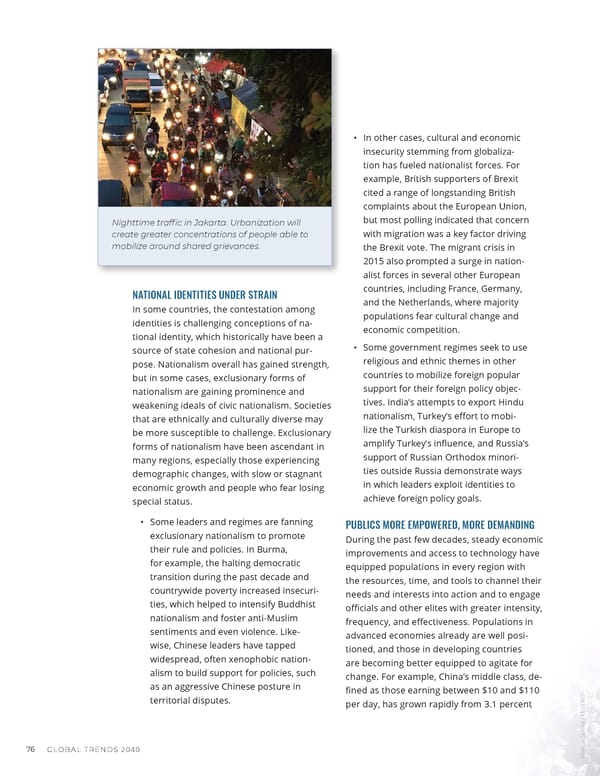
• In other cases, cultural and economic insecurity stemming from globaliza- tion has fueled nationalist forces. For example, British supporters of Brexit cited a range of longstanding British complaints about the European Union, but most polling indicated that concern Nighttime traffic in Jakarta. Urbanization will with migration was a key factor driving create greater concentrations of people able to mobilize around shared grievances. the Brexit vote. The migrant crisis in 2015 also prompted a surge in nation- alist forces in several other European NATIONAL IDENTITIES UNDER STRAIN countries, including France, Germany, In some countries, the contestation among and the Netherlands, where majority identities is challenging conceptions of na- populations fear cultural change and tional identity, which historically have been a economic competition. source of state cohesion and national pur- • Some government regimes seek to use pose. Nationalism overall has gained strength, religious and ethnic themes in other but in some cases, exclusionary forms of countries to mobilize foreign popular nationalism are gaining prominence and support for their foreign policy objec- weakening ideals of civic nationalism. Societies tives. India’s attempts to export Hindu that are ethnically and culturally diverse may nationalism, Turkey’s e昀昀ort to mobi- be more susceptible to challenge. Exclusionary lize the Turkish diaspora in Europe to forms of nationalism have been ascendant in amplify Turkey’s in昀氀uence, and Russia’s many regions, especially those experiencing support of Russian Orthodox minori- demographic changes, with slow or stagnant ties outside Russia demonstrate ways economic growth and people who fear losing in which leaders exploit identities to special status. achieve foreign policy goals. • Some leaders and regimes are fanning PUBLICS MORE EMPOWERED, MORE DEMANDING exclusionary nationalism to promote During the past few decades, steady economic their rule and policies. In Burma, improvements and access to technology have for example, the halting democratic equipped populations in every region with transition during the past decade and the resources, time, and tools to channel their countrywide poverty increased insecuri- needs and interests into action and to engage ties, which helped to intensify Buddhist o昀케cials and other elites with greater intensity, nationalism and foster anti-Muslim frequency, and e昀昀ectiveness. Populations in sentiments and even violence. Like- advanced economies already are well posi- wise, Chinese leaders have tapped tioned, and those in developing countries widespread, often xenophobic nation- are becoming better equipped to agitate for alism to build support for policies, such change. For example, China’s middle class, de- as an aggressive Chinese posture in 昀椀ned as those earning between $10 and $110 territorial disputes. per day, has grown rapidly from 3.1 percent 76 GLOBAL TRENDS 2040 Markus Spiske / Unsplash
 GlobalTrends 2040 Page 83 Page 85