

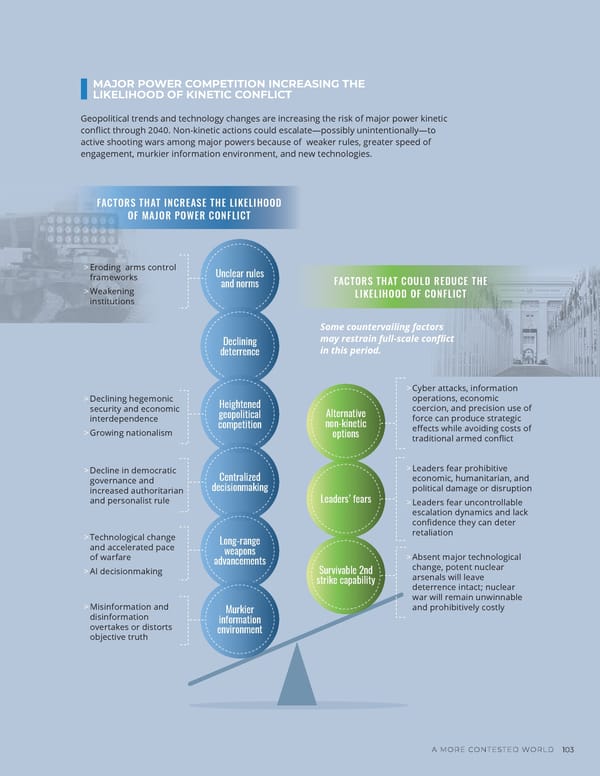
MAJOR POWER COMPETITION INCREASING THE LIKELIHOOD OF KINETIC CONFLICT Geopolitical trends and technology changes are increasing the risk of major power kinetic conflict through 2040. Non-kinetic actions could escalate—possibly unintentionally—to active shooting wars among major powers because of weaker rules, greater speed of engagement, murkier information environment, and new technologies. FACTORS THAT INCREASE THE LIKELIHOOD OF MAJOR POWER CONFLICT > Eroding arms control Unclear rules frameworks and norms FACTORS THAT COULD REDUCE THE > Weakening LIKELIHOOD OF CONFLICT institutions Some countervailing factors Declining may restrain full-scale conflict deterrence in this period. > Cyber attacks, information > Declining hegemonic Heightened operations, economic coercion, and precision use of security and economic geopolitical Alternative interdependence competition non-kinetic force can produce strategic > Growing nationalism options effects while avoiding costs of traditional armed conflict > Decline in democratic Centralized > Leaders fear prohibitive governance and decisionmaking economic, humanitarian, and political damage or disruption increased authoritarian Leaders’ fears and personalist rule > Leaders fear uncontrollable escalation dynamics and lack confidence they can deter > Technological change Long-range retaliation and accelerated pace weapons of warfare advancements > Absent major technological > AI decisionmaking Survivable 2nd change, potent nuclear strike capability arsenals will leave deterrence intact; nuclear war will remain unwinnable > Misinformation and Murkier and prohibitively costly disinformation information overtakes or distorts environment objective truth A MORE CONTESTED WORLD 103
 GlobalTrends 2040 Page 110 Page 112