

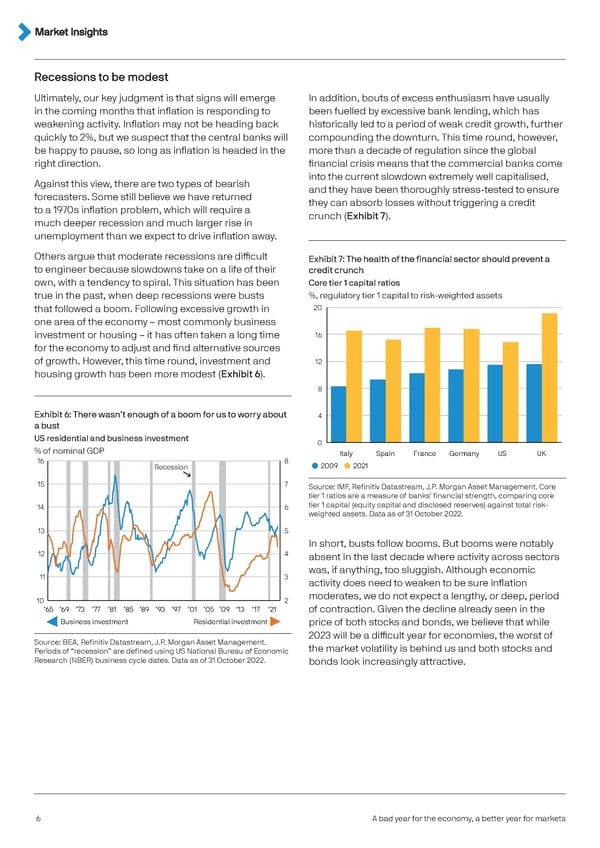
Recessions to be modest Ultimately, our key judgment is that signs will emerge In addition, bouts of excess enthusiasm have usually in the coming months that inflation is responding to been fuelled by excessive bank lending, which has weakening activity. Inflation may not be heading back historically led to a period of weak credit growth, further quickly to 2%, but we suspect that the central banks will compounding the downturn. This time round, however, be happy to pause, so long as inflation is headed in the more than a decade of regulation since the global right direction. financial crisis means that the commercial banks come Against this view, there are two types of bearish into the current slowdown extremely well capitalised, forecasters. Some still believe we have returned and they have been thoroughly stress-tested to ensure to a 1970s inflation problem, which will require a they can absorb losses without triggering a credit much deeper recession and much larger rise in crunch (Exhibit 7). unemployment than we expect to drive inflation away. Others argue that moderate recessions are difficult Exhibit 7: The health of the financial sector should prevent a to engineer because slowdowns take on a life of their credit crunch own, with a tendency to spiral. This situation has been Core tier 1 capital ratios true in the past, when deep recessions were busts %, regulatory tier 1 capital to risk-weighted assets that followed a boom. Following excessive growth in 20 one area of the economy – most commonly business investment or housing – it has often taken a long time 16 for the economy to adjust and find alternative sources of growth. However, this time round, investment and 12 housing growth has been more modest (Exhibit 6). 8 Exhibit 6: There wasn’t enough of a boom for us to worry about 4 a bust US residential and business investment 0 % of nominal GDP Italy Spain France Germany US UK 16 Recession 8 2009 2021 15 7 Source: IMF, Refinitiv Datastream, J.P. Morgan Asset Management. Core tier 1 ratios are a measure of banks' financial strength, comparing core 14 6 tier 1 capital (equity capital and disclosed reserves) against total risk- weighted assets. Data as of 31 October 2022. 13 5 In short, busts follow booms. But booms were notably 12 4 absent in the last decade where activity across sectors was, if anything, too sluggish. Although economic 11 3 activity does need to weaken to be sure inflation 10 2 moderates, we do not expect a lengthy, or deep, period ’65 ’69 ’73 ’77 ’81 ’85 ’89 ’93 ’97 ’01 ’05 ’09 ’13 ’17 ’21 of contraction. Given the decline already seen in the Business investment Residential investment price of both stocks and bonds, we believe that while Source: BEA, Refinitiv Datastream, J.P. Morgan Asset Management. 2023 will be a difficult year for economies, the worst of Periods of “recession” are defined using US National Bureau of Economic the market volatility is behind us and both stocks and Research (NBER) business cycle dates. Data as of 31 October 2022. bonds look increasingly attractive. 6 A bad year for the economy, a better year for markets
 J.P. Morgan Investment Outlook 2023 Page 5 Page 7