

Performance Food Group ESG Report
1 2021 ESG REPORT ©2021 Performance Food Group
2 PFG’s 2021 ESG Report details our progress on company-wide environmental, social and governance (ESG) management approach and performance. This report represents our primary source of annual ESG disclosure and is based on our ESG focus areas that were identified through a comprehensive ESG audit and materiality analysis. All information in this ESG Report covers PFG’s Fiscal 2021 period between June 28th, 2020 and July 3rd, 2021, unless otherwise stated. This report presents the opportunity to communicate our ongoing commitment to integrating ESG across our organization, including PFG’s first set of ESG goals aligned with areas of focus most relevant to our business and to our stakeholders. This year’s report also includes disclosures aligned with standards and recommendations from the Sustainable Accounting Standards Boards (SASB) and the Task Force for Climate-related Financial Disclosures (TCFD). PFG management, business units and credible third parties assisted in the process of collecting, analyzing and calculating data and information for this ESG Report. PFG did not seek or receive any external assurance for information and data contained in this report. This report contains some forward-looking statements. These statements are based on what the company reasonably believes to be achievable, as well as assumptions made by, and information currently available to, management. Actual results and outcomes could differ materially due to several factors, including, but not limited to, risks associated with the business, uncertainties or assumptions that may not prove to be accurate. The company does not undertake any obligation to update or review the forward-looking statements contained in this report. Throughout our ESG Report we use terms that ESG reporting guidelines and frameworks refer to as “material” issues or “materiality” to reflect the topics that are considered of relevance to the company and/or its stakeholders. In this context, issues considered material for the purpose of this report or the determination of the company’s ESG strategies may not be considered material for SEC reporting purposes and should not be confused with the terms “material” and “materiality” as defined by securities laws. ABOUT THIS REPORT
3 TABLE OF CONTENTS LETTER FROM THE CEO ................................................................................... 4 ABOUT PFG ..................................................................................................... 5 OUR COMMITMENT TO ESG ............................................................................. 6 ESG GOALS / KEY ISSUES & AREAS OF FOCUS ............................................ 7-8 OUR ENVIRONMENTAL PERFORMANCE ........................................................... 9 Environmental Management .................................................................... 10 Climate Change & Carbon Management ................................................... 11 Energy & Fuel Management .................................................................... 12 Electric Power ................................................................................ 12 Fuel ............................................................................................... 13 Air Emissions ......................................................................................... 14 Waste Management ................................................................................ 14 Sustainable Packaging & Non-Food Products ........................................... 15 Water Management ................................................................................ 16 OUR SOCIAL PERFORMANCE ......................................................................... 17 Responsible Sourcing .............................................................................. 18 Food Safety & Accountability ................................................................... 19 Ingredient Transparency .......................................................................... 19 Health & Nutrition of Products ................................................................. 20 Human Rights ......................................................................................... 21 Diversity & Inclusion (D&I) ........................................................................ 22 D&I at PFG ..................................................................................... 22 D&I within our Supply Chain ............................................................ 22 Human Capital Management ................................................................... 23 Associate Engagement & Appreciation ............................................. 23 Compensation & Benefits ................................................................ 23 Associate Support .......................................................................... 24 Training & Development .................................................................. 24 Occupational Health & Safety .................................................................. 25 Community Engagement & Collaboration .................................................. 26 Fighting Food Insecurity .................................................................. 26 Truckers Against Trafficking ............................................................. 26 Healthier Hearts & Communities ...................................................... 27 Responding to Disasters ................................................................. 27 OUR GOVERNANCE ........................................................................................ 28 Our Approach to ESG Governance ............................................................ 29 Board Snapshot .............................................................................. 29 Corporate Governance Highlights ..................................................... 29 Data Privacy & Security ........................................................................... 30 Code of Business Conduct ...................................................................... 31 Supplier Code of Conduct ........................................................................ 31 TASKFORCE-CLIMATE-RELATED FINANCIAL DISCLOSURE ............................ 32 Executive Summary ................................................................................ 33 Governance ............................................................................................ 33 Strategy ............................................................................................ 34-36 Risk Management ................................................................................... 37 Metrics & Targets .................................................................................... 38 SUSTAINABILITY ACCOUNTING STANDARDS BOARD INDEX .......................... 39 (SASB) Food Retailers & Distributors Standard ................................................ 40-41
LETTER FROM THE CEO Fiscal 2021 was an eventful year. The continued impacts of the global pandemic, increased focus on climate change and climate risk, and a continued call for companies to participate in a larger social dialogue on race and equality all meant that companies like ours were being called on to address far more than just managing our business for profitable growth, quality and consistency. These unprecedented times highlighted the importance of embedding environmental and social action into our day-to-day business planning, both to address external societal expectations and to help PFG prepare for business risks and new business opportunities that such focus has created. One thing we know for sure, business-as-usual is not an option anymore. As PFG continues to grow and provide essential support to the foodservice sector, we know that doing so means we must also be prepared to show how we are leveraging ESG to address the expectations of our shareholders, our customers and our associates. In our 2020 Corporate Social Responsibility Report, we introduced our commitment to the principles that guide our ESG journey: Impact, Innovate and Inspire. Today, that journey continues, and we have undertaken some significant steps towards delivering on our commitment. These include setting a meaningful strategy for ESG across the company and leveraging the internal, cross-functional committees that we have created to help us manage our ESG efforts. In addition, I am very proud to announce that as a result of this work, we have developed our first set of comprehensive ESG goals, which include specific targets in areas such as responsible sourcing, D&I, associate engagement and development, energy efficiency, renewable energy, waste management and community engagement. This year we announced our partnership for a 2.25 megawatt community solar project in Maine and we engaged a third-party expert to help us analyze potential renewable energy purchasing opportunities and our greenhouse gas emissions. We also launched an ESG Supplier Survey across our supply chain, which is helping us to better understand the ESG performance of our many vendor partners. I am particularly proud to share that we are developing a comprehensive strategy focused on strengthening an inclusive and equitable culture at PFG and fostering diversity among our partnerships throughout our supply chain. We have a full-time executive focused entirely on Diversity & Inclusion and in meeting PFG’s imperative to provide an equitable work environment for all of our team members. This report will provide more detail on our ESG activities and performance. We recognize we have much more work to do, and we are committed to integrating ESG across all aspects of our business strategy and culture. On behalf of the Board of Directors and leadership at PFG, I want to thank our associates for their exceptional commitment to driving ESG progress across the organization, and our customers and business partners for joining us in our journey to deliver a sustainable future with nutritious food for all. George Holm Chairman, President & CEO 4
5 Through its subsidiaries, Performance Food Group (PFG) Company markets and distributes approximately 250,000 food and food-related products from 107 distribution centers to over 250,000 customer locations across the United States. Our 23,000 associates serve a diverse mix of customers, from independent and chain restaurants to schools, business and industry locations, hospitals, vending distributors, office coffee service distributors, retailers, convenience stores, and theaters. We work to build lasting relationships with our customers, doing everything we can to ensure success. Over the years, we have listened to our customers and transformed to better support their needs. Performance Food Group was established in 1987, and we continued to grow and evolve as our leaders acted on their vision for a new company that would bring together a network of distributors with the corporate support to become an industry giant. We have two main operating segments – Foodservice and Vistar. Foodservice offers quality brands of food and related products to independent restaurants, chain restaurants, and other institutional “food-away-from-home” locations. Vistar is a leading national distributor of candy, snacks, beverages, coffee and other non-food items to vending and office coffee service distributors, big box retailers, theaters, convenience stores and hospitality providers. Each segment has its own success story, but with a shared theme — adaptability. We don’t just show our customers what’s happening today, we show them what’s coming next. As a group, we can meet almost any foodservice need, from independent restaurants to national chains, vending, concessions and more. We’re innovators in procurement, warehousing, supply chain management, customer service and delivery because our leaders are always looking for opportunities to improve our business and the industry. We source our products from diverse suppliers and serve as a key partner by providing them access to our customer base. In addition to products, we provide our customers with valuable services using our industry knowledge and expertise in the areas of product selection and procurement, menu development and operational strategy. At PFG, we strive to provide access to nutritious, sustainable and high-quality products to every community we serve. PERFORMANCE FOOD GROUP
PFG has made a commitment to improving our performance on key ESG issues. We strive to not only meet all environmental regulations and requirements at each of our locations and distribution centers, but also to continuously improve our ESG performance across our business and our supply chain. Our approach to ESG integration in 2021 was framed through a strengths-based strategic planning process with our dedicated ESG Executive Steering Committee and ESG subcommittee working groups. The ESG Executive Steering Committee reports directly to the Nominating and Governance Committee of the PFG Board of Directors, which has oversight over environmental strategies and programs, health and safety, corporate social responsibility, diversity and inclusion, corporate governance, sustainability and other ESG matters. Management reviews PFG’s strategies, practices, policies, initiatives and public ESG disclosures with the Nominating and Corporate Governance Committee on a quarterly basis. This structure enables us to identify where and how we can build on elements we already have in place across the enterprise, what areas require greater information gathering and stakeholder engagement, and what fundamental risks and opportunities exist in the immediate and long-term. To support the ESG Executive Steering Committee, we set up cross-functional working groups designed to help us develop and manage our ESG strategy. Those include Supply Chain, Operations, Transparency and Disclosure, Ingredient Transparency, Non-Foods and Associate Engagement & Wellbeing. PFG is committed to integrating our ESG initiatives across our business and embedding ESG performance into our business culture to ensure that we can continue to deliver exceptional service and value to our customers and also establish PFG as a responsible corporate citizen actively engaged in working to make the world a better place. COMMITMENT TO ESG Our 6
7 KEY ISSUES & AREAS OF FOCUS ESG Goals In 2021 PFG developed our first set of ESG goals. These goals were developed by our leadership and internal ESG teams and reviewed with our Board of Directors. The goals are connected to the areas we believe are of most importance to our business, our shareholders, our customers and our associates. To set these goals, we identified several key areas of focus important to our business and to our stakeholders. OPERATIONS & SUSTAINABLE PERFORMANCE We are working across the business to mitigate our environmental impact. This includes a focus on energy, climate, water and waste. SUPPLY CHAIN & RESPONSIBLE SOURCING PFG understands the critical role our vendors play in helping us achieve our ESG objectives. We are actively focused on the development and deployment of responsible sourcing efforts and robust engagement with our supply chain. ASSOCIATE ENGAGEMENT & DIVERSITY & INCLUSION We understand that our success depends on our people. It is essential that we provide a workplace where all team members, present and future, feel safe and empowered to succeed.
8 FOCUS AREAS GOAL Energy Efficiency Reduce power consumption intensity by 20% by 2030 against our fiscal 2020 baseline. Renewable Energy Secure 10% of purchased electricity from renewable sources by 2030. Greenhouse Gas Emissions Establish an enterprise-wide carbon reduction target by 2022, covering Scope 1 & 2 greenhouse gas emissions. Waste Management Achieve an 80% diversion rate for operational waste by 2030. Responsible Sourcing Ensure 90% of PFG branded beef, pork, poultry, seafood, coffee and tea are produced with verified environmentally sustainable and socially responsible practices by 2025. In alignment with the Supplier Code of Conduct, conduct an ESG Supplier Survey with 95% of suppliers of PFG branded products by 2022. Develop an environmentally preferable purchasing program for PFG branded non-food products by 2023, expanding sustainable offerings for our customers. Associate Engagement & Development Enhance PFG’s culture and promote engagement by using feedback and results from an enterprise Associate Engagement Survey conducted every two years. Build PFG’s Center for Learning model to help align associate goals while driving business results through delivery of training and development curriculums and opportunities. Diversity & Inclusion Implement women and other associate resource groups to create awareness, amplify experiences, and develop cultural fluency by 2022. Integrate comprehensive diversity and inclusion strategies into PFG’s talent acquisition and learning and development processes by 2023. Increase purchases with woman-, veteran-, and minority-owned businesses by 25% by 2030. Community Engagement Expand advocacy, volunteerism and charitable contributions with organizations committed to fighting food insecurity, supporting healthier communities and providing disaster relief. KEY ISSUES & AREAS OF FOCUS ESG Goals
9 ENVIRONMENTAL PERFORMANCE Our ENVIRONMENTAL MANAGEMENT CLIMATE CHANGE & CARBON MANAGEMENT ENERGY & FUEL MANAGEMENT - Electric Power - Fuel AIR EMISSIONS WASTE MANAGEMENT SUSTAINABLE PACKAGING & NON-FOOD PRODUCTS WATER MANAGEMENT
10 ENVIRONMENTAL MANAGEMENT At Performance Food Group, we strive to be a responsible environmental steward by protecting the environment for future generations. We comply with all environmental laws and regulations and are committed to mitigating our environmental footprint through the efficient use of natural resources, the implementation of innovative technologies and solutions across PFG, and the advancement of sustainable practices throughout our supply chain. At the center of this commitment is our Environmental Policy that outlines individual and shared responsibilities for the implementation of environmental management standards and best practices pertaining to environmental impact reduction, risk management, stakeholder engagement and ESG reporting. Environmental risks are registered and monitored by the company’s Enterprise Risk Management (ERM) function and are integrated into our business continuity contingency plans and emergency action protocols for applicable locations. Significant environmental risks are included within the company’s enterprise business risk register and updates are regularly provided to the Audit Committee of the Board of Directors. As part of our efforts to improve our environmental performance, we have established environmental baselines, targets and performance metrics in key matters central to our ESG Strategy: energy efficiency, renewable energy, climate change, greenhouse gas and waste management. Progress on these strategic environmental targets and initiatives is reported to the Nominating and Corporate Governance Committee of the Board on a quarterly basis. We are committed to mitigating our environmental footprint through the efficient use of natural resources, the implementation of innovative technologies and solutions across Performance Food Group , and the advancement of sustainable practices throughout our supply chain.
11 CLIMATE CHANGE & CARBON MANAGEMENT Climate change has become the defining issue of our time and its impacts are threatening our global food system and the wellbeing of both the people and the communities that rely on food and agriculture for their livelihoods. Physical impacts of climate change can result in significant disruptions across our operations as well as throughout our supply chain. Extreme weather events and chronic impacts of global rising temperatures can affect the consistent availability and pricing for agricultural commodities that PFG relies on. In addition, the transition towards a low-carbon economy, changing consumer expectations, and stricter regulatory frameworks also present a set of risks and opportunities that have the ability to impact our business and our stakeholders. Given the significance of the challenges and opportunities associated with climate change, we have published an enterprise Climate Change Policy to guide our approach to the following: • Climate change governance at PFG • Climate change risk management integration and strategy • Support for regenerative agriculture and sustainable product adoption • Greenhouse gas emission measurement and reduction targets As part of the commitments stated in our Policy, we conducted an analysis of our greenhouse gas emissions and established an emissions baseline as the foundation for developing a carbon reduction roadmap and determining the best pathways for reducing our emissions across our operations. In fiscal 2021, we completed this task and developed a complete greenhouse gas inventory of our Scope 1 and Scope 2 emissions. We also set the following goals focused on decreasing the energy and carbon intensity of our operations: • Reduce power consumption intensity by 20% by 2030 against our fiscal 2020 baseline • Secure 10% of purchased electricity from renewable sources by 2030 Senior management reports on the progress on these goals to the Nominating and Corporate Governance Committee on a quarterly basis, ensuring Board oversight on key energy efficiency, renewable energy and carbon reduction initiatives. By the end of fiscal 2022, we aim to set an enterprise-wide carbon emissions reduction target and a multi-year action plan for meeting the goal. GREENHOUSE GAS EMISSIONS INVENTORY FISCAL 2021 - METRIC TONS 1 SCOPE 1 663,670 SCOPE 2 (LOCATION-BASED) 149,896 SCOPE 2 (MARKET-BASED) 150,403 1 Our greenhouse gas emissions inventory has been developed in alignment with the GHG Protocol for Corporate Accounting and Reporting Standard of the World Resources Institute and the World Business Council for Sustainable Development.
12 ENERGY & FUEL MANAGEMENT – ELECTRIC POWER Warehousing and distribution of food products for human consumption is an energy intensive business. Electric power is used for refrigeration, heating, ventilation, HVAC systems and lighting. Electricity usage represents a significant cost across our operations and contributes to approximately 18% of our greenhouse gas emissions. At PFG, 367,701 megawatt hours (MWh) of electric power was consumed across our enterprise during fiscal 2021. As part of our commitment to improve efficiency of our operations, reduce our carbon footprint, and maximize energy cost savings opportunities, we have set a goal to reduce our power consumption intensity by 20% by 2030 . To achieve this goal, we will focus on implementing strategic energy efficiency projects throughout our facilities by investing in energy-saving technologies and optimizing operations and maintenance practices. ENERGY EFFICIENCY TREASURE HUNT PILOT PROGRAM During fiscal 2021, we rolled out an Energy Efficiency Treasure Hunt pilot program at our Performance Foodservice – Chicago location. Personnel at this refrigerated warehouse facility partnered with a third- party energy management consulting firm to explore efficiency opportunities for reducing energy use, electricity costs and emissions within our refrigeration, lighting and charging systems. This pilot program has led to the identification of energy saving opportunities and successful implementation of low-cost behavioral, operational and maintenance actions, reducing the energy intensity of the facility by realizing a 14% reduction in the amount of electric power consumed per shipped case . In addition to achieving utility cost savings, these actions are expected to produce an annualized energy savings of over 681,000 kWh and a mitigation of over 600 metric tons of greenhouse gas emissions. Given the results achieved through this pilot program, over the next year we will roll out additional Energy Efficiency Treasure Hunts to other facilities and review and implement low-cost power usage reduction recommendations across the enterprise. RENEWABLE ENERGY PROCUREMENT In addition to reducing our carbon footprint through operational efficiencies, we are exploring renewable power purchasing agreements and leveraging national- and state-level tax incentives to procure more wind and solar energy across our enterprise. As part of our climate-related commitments, we have set an enterprise goal to secure 10% of purchased electricity from renewable sources by 2030. At PFG, we have already taken the next steps in delivering on this commitment to expand renewable energy procurement throughout the organization. We established a process for evaluating and implementing power purchasing agreements and, in July 2021, we announced a 20-year net metering credit agreement with EDPR NA Distributed Generation, a subsidiary of EDP Renewables North America. Through this collaborative endeavor in New Vineyard, Maine, we will purchase power generated from the 2.25 megawatt (MW) solar project, estimated at 3,000 MWh of clean energy per year . The project is anticipated to commence generating renewable power in 2022. This will address 80% of the electric power usage at our Performance Foodservice – NorthCenter location in Augusta, Maine, while reducing our carbon footprint and contribution to climate change. The renewable power generated annually by this project represents 2,103 metric tons of avoided CO 2 emissions , equivalent to removing nearly 460 passenger vehicles from the road, or the carbon sequestered by 2,746 acres of forest . We are confident that a combination of growing tax incentives and more expansive renewable infrastructure will enable PFG to power its facilities while significantly reducing the carbon emissions associated with its day-to-day operations. DEMAND RESPONSE We have implemented a demand response program by working with utility providers to reduce energy use during peak demand hours through management practices and training for associates. We have achieved utility cost savings by reducing demand during peak periods or shifting energy use to times of day when there is less demand on the grid or when more renewable energy is available. This also contributes to our efforts to align our operations with environmental best practices. By participating in these voluntary reductions or shifts in energy, we take an active role in reducing stress on the grid, decreasing air pollution and improving air quality.
13 FLEET FUEL Fleet fuel is our third most significant transportation cost, after labor and vehicles, and the largest contributor to our operations’ greenhouse gas emissions, representing 62% of our carbon footprint. As a result, improving our fleet fuel management is both a financial opportunity and a way to advance our strategic vision for reducing our carbon emissions. We use an integrated approach to fleet fuel management that combines associate engagement and training, low-carbon technologies, and strategically located redistribution centers. Reducing our carbon intensity and achieving greater fuel efficiencies help reduce costs, mitigate risks associated with fuel price volatility, hedge against carbon taxes and align our operations with the transition to a low-carbon economy. In fiscal 2021, 48.7 million gallons of diesel were consumed throughout our operations. To reduce the carbon intensity of our operations, we have employed the following efficiency and low-carbon strategies that, assuming current business conditions, can achieve a 20% reduction in gallons of diesel consumed per delivered case within the next 10 years: RENEWABLE & ALTERNATIVE ENERGY We are currently exploring and evaluating technology for powering tractors and trailers with electric and alternative fuel solutions. PFG actively monitors the evolution of low-carbon technologies for powering freight transportation and has identified the opportunity to pilot electric trailer refrigeration technology for reducing fuel usage and carbon emissions associated with fleet refrigeration, commencing in fiscal 2022. FLEET LIFECYCLE MANAGEMENT PFG actively manages the lifecycle of the vehicles within its fleet and implements a comprehensive strategy for vehicle replacement, incorporating fuel efficient vehicles that improve the overall fuel economy and operational efficiency of our fleet. ROUTE OPTIMIZATION We continue to implement route optimization best practices and training initiatives using RoadNet technology that enables PFG to select the most efficient routes for product distribution. Route optimization, in conjunction with strategically located redistribution centers, allows us to minimize our miles traveled, time spent on the road, fuel usage and our carbon emissions on a per-case basis.
14 AIR EMISSIONS Refrigeration is a core component of our operations and is essential to food safety throughout our warehousing and distributions processes. However, leakage of refrigerant gases into the atmosphere can contribute to ozone depletion and global warming, representing approximately 16% of our carbon emissions. To mitigate emissions from our facility refrigeration and fleet refrigeration systems, we procure a combination of refrigeration products that allow us to meet our strict food and product safety requirements with the lowest possible emissions. As part of this effort, we seek to use refrigerants with a lower greenhouse gas potential within our refrigeration processes. We are confident that emerging sustainable refrigerant technologies and our procurement of more renewable energy will help to lower our carbon footprint associated with commercial refrigeration as we look to find a more long-term, systemic solution to this unique industry challenge. In addition, 99.95% of all refrigerants consumed across PFG have a validated ozone depletion potential (ODP) score of zero, meaning the compound has no degradation impact on the ozone layer. OPERATIONAL WASTE We monitor operational waste and food waste to ensure we can minimize the creation of waste and look for ways to divert as much of that waste from landfill as possible. We view operational waste as material waste generated from the operation of our facilities. We are actively tracking the recycling of our pallets, stretch wrap and corrugate. PFG has established an effective approach to capture and recycle pallets that has led to the diversion of approximately 7 million pallets from landfills. For fiscal 2021, our waste diversion numbers show a total diversion from landfill of 73%. • TOTAL POUNDS RECYCLED (stretch and corrugated): 16,341,194 • TOTAL POUND PALLETS RECYCLED: 280,841,952 • TOTAL WASTE POUNDS (including recycled): 407,658,946 • TOTAL DIVERTED FROM LANDFILL: 73% WASTE MANAGEMENT
15 WASTE MANAGEMENT CONT. FOOD WASTE At PFG, we recognize the immediate environmental and societal challenges that food waste represents and its impact on natural resources required for food production, including water, land and energy, as well as its contribution to greenhouse gas emissions and food insecurity. In fiscal 2021, we generated a total of 46,601,483 pounds of food waste. Of that, 18,261,239 pounds or 39% of our food waste generated, was diverted from landfills. To mitigate the risks associated with food loss and waste, PFG establishes and leverages partnerships with national and regional foodbanks that help us address food insecurity while also reducing our company’s carbon footprint. We also partner with our suppliers to ensure they employ environmental management policies and standards and are actively minimizing their waste generation within their production processes. For example, we work with some of our branded beef suppliers in improving the meat trimming specifications to decrease food waste generated at the restaurant level. This minimizes the amount of waste that ends up in the landfill, reducing carbon emissions associated with food decomposition. SUSTAINABLE PACKAGING & NON-FOOD PRODUCTS At PFG, we understand the environmental risk and impact that single-use plastics have on our oceans, soils, ecological habitats and on the climate. We have a strategy for reducing our contribution to packaging pollution and environmental degradation throughout the value chain by expanding our branded non-foods sustainable product offerings. This is only achievable by partnering with select non-food suppliers that provide recyclable, biodegradable and compostable foodservice items and have packaging design processes based on product lifecycle analysis and management, as well as systematic approaches to reducing water use, energy use, landfill waste and greenhouse gas emissions. As an example, in November 2020, our Vistar segment entered a partnership with Emerald Brand to expand the offering of sustainable disposables and essentials for our customers across the United States. Emerald Brand items include cutlery, cups, bowls and plates, containers, napkins, towels, toilet and facial tissue, and other essentials that are Tree-Free™ and free of petroleum- based plastic. The TreeFree™ items come from plant-based agricultural waste, providing an alternative to traditional paper products. As a sustainable alternative to petroleum-based plastics, Emerald Brand uses PLA or PHA which is compostable/biodegradable, BPA free, fluorocarbon free and USDA Certified BioBased. By partnering with Emerald Brand to provide products free of virgin wood fiber and petroleum- based plastics, in fiscal 2021 we were able to contribute to the following estimated environmental savings 2 : • 63,286 kWh of energy saved. • 54,378 pounds of greenhouse emissions saved, equivalent to 95,195 miles driven. • 950 total avoided trees, equivalent to saving 19,083 reams of copy paper. • 295,784 gallons of water saved, equivalent to 822 hours of lawn watering • Avoided 120,775 pound of plastic, equivalent to 10,869,779 plastic bags • Avoided 156,402 pounds of landfill waste, equivalent to 39 dumpsters. In January 2021, we also partnered with WestRock, one of our non-food items supplier partners for PFG-branded pizza boxes, to deliver the Sustainable Choices™ program with the aim of raising awareness around the recyclability of pizza boxes and their acceptance in residential recycling programs. Through this program, the pizza boxes provided to our customers include a QR code that leads to an online portal that allows consumers to look up their recycling guidelines by zip code as well as additional materials to bring clarity to the issue of corrugated pizza box recycling. For example, according to a study performed by WestRock, 73% of the U.S. population is estimated to have recycling programs available for pizza boxes, but many consumers are under the false impression that recycling pizza boxes is not allowed. By partnering with WestRock, we seek to clear this confusion, help customers make sustainable choices, and increase the volume of fiber returning to the circular economy. 2 Environmental savings estimates are provided by Emerald Brand and are based on conversion from products of the same weight made entirely of virgin wood fiber and/or petroleum-based plastic resin.
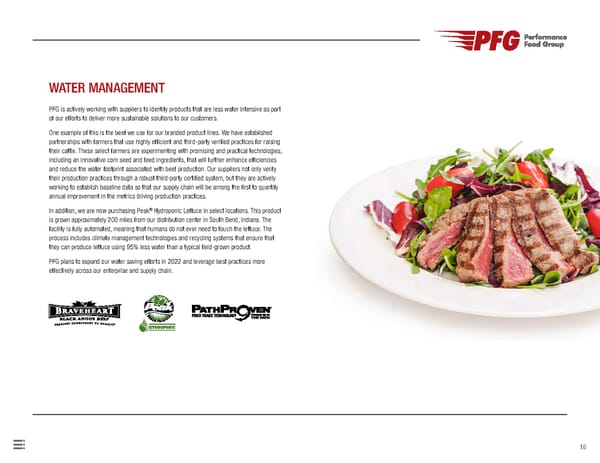
16 WATER MANAGEMENT PFG is actively working with suppliers to identify products that are less water intensive as part of our efforts to deliver more sustainable solutions to our customers. One example of this is the beef we use for our branded product lines. We have established partnerships with farmers that use highly efficient and third-party verified practices for raising their cattle. These select farmers are experimenting with promising and practical technologies, including an innovative corn seed and feed ingredients, that will further enhance efficiencies and reduce the water footprint associated with beef production. Our suppliers not only verify their production practices through a robust third-party certified system, but they are actively working to establish baseline data so that our supply chain will be among the first to quantify annual improvement in the metrics driving production practices. In addition, we are now purchasing Peak ® Hydroponic Lettuce in select locations. This product is grown approximately 200 miles from our distribution center in South Bend, Indiana. The facility is fully automated, meaning that humans do not ever need to touch the lettuce. The process includes climate management technologies and recycling systems that ensure that they can produce lettuce using 95% less water than a typical field-grown product. PFG plans to expand our water saving efforts in 2022 and leverage best practices more effectively across our enterprise and supply chain.
17 SOCIAL PERFORMANCE Our RESPONSIBLE SOURCING FOOD SAFETY & ACCOUNTABILITY INGREDIENT TRANSPARENCY HEALTH & NUTRITION OF PRODUCTS HUMAN RIGHTS DIVERSITY & INCLUSION (D&I) - D&I at PFG - D&I within our Supply Chain HUMAN CAPITAL MANAGEMENT - Associate Engagement & Appreciation - Compensation & Benefits - Associate Support - Training & Development OCCUPATIONAL HEALTH & SAFETY COMMUNITY ENGAGEMENT & COLLABORATION - Fighting Food Insecurity - Truckers Against Trafficking - Healthier Hearts & Communities - Responding to Disasters
18 RESPONSIBLE SOURCING Performance Food Group is committed to managing our business in a socially responsible manner. We have an obligation to our customers, our investors, and our associates to address issues that impact our world and our global food system. We believe that working closely with our vendors can allow us to address the inherent ESG risks within global supply chains and identify opportunities for better ways to do business and create value for all our stakeholders. In this spirit, in fiscal 2021 we initiated an ESG Supplier Survey Program to facilitate deeper insight into areas of alignment and potential collaboration with suppliers across a variety of ESG matters. As part of this initiative, we launched an ESG supplier survey focused on assessing our suppliers’ efforts on key topics, including: • Environmental Management • Human Rights & Labor Management • Animal Welfare • Health & Wellness • Ingredient Transparency and Traceability • Farming, Production Methods, Suppliers of Suppliers The results of the survey will help PFG assess the ESG performance of our suppliers and determine where opportunities for collaboration and partnership exist, as well as to identify potential supply chain risks that need to be addressed. As part of our responsible sourcing program, we have implemented processes for monitoring and verifying third-party certification of environmental and socially responsible practices within our supply chains. These certifications ensure that risk is reduced across our supply chains and that our procurement strategy is aligned with consumer expectations and our commitment to promoting the adoption of sustainable food and foodservice products, practices and services. To monitor ESG-related certifications in our supply chain, a second survey was distributed specifically to suppliers of PFG-branded products. We are taking measures to drive sustainable and responsible sourcing of our food products and committed to working with our suppliers to ensure that 90% of PFG-branded beef, pork, poultry, seafood, coffee and tea are produced with verified environmentally sustainable and socially responsible practices by 2025 . In addition to working with suppliers with sustainability certifications, PFG-owned businesses directly implement responsible sourcing best practices with coffee farmers and their communities, where we have the opportunity to do so. Such is the case with PFG’s Coda Coffee Co., one of the best craft coffee roasters in the industry that is known not only for its wide variety of rich flavors but for its commitment to working with its growers to influence the implementation of sustainable growing practices, exceeding fair trade practices and sourcing the best beans from around the globe. Due to this vision and commitment to sustainability, Coda Coffee Co. has achieved Certified B Corporation ™ status since 2013, meeting rigorous verified standards of environmental and social performance. B Corp Certification is a highly selective status and to maintain certification, companies must undergo verification every three years.
19 FOOD SAFETY & ACCOUNTABILITY At PFG, our greatest responsibility is to ensure that every product we carry is safe for human consumption. Food contamination by pathogens, hazardous substances or spoilage presents significant human health risks to consumers. We actively mitigate these inherent risks within the food system across our global supply chains, from food production to processing to distribution. Our approach to food safety incorporates rigorous warehousing and distribution temperature controls, a methodical approach to supplier screening and selection, and a comprehensive PFG Quality Assurance Program for controlling biological, physical and chemical hazards throughout the supply chain. This program is designed and managed by a team comprised of a company- wide network of associates with over a century of combined food safety expertise and doctorate- level knowledge. As a food distributor, PFG is not responsible for initiating food recalls on prepackaged items sold to customers, but does have robust recall management procedures in place to respond to these types of recalls, which are the majority that could affect the company. For the few PFG-owned and operated food production facilities, PFG would be responsible for initiating product recalls if a product was deemed potentially unsafe for consumption by regulatory inspection or our own routine quality assurance verification of the PFG food safety procedures for each unique facility. As part of our commitment to the wellbeing of our stakeholders and our dedication to quality, we will continue to build upon our Quality Assurance Program to ensure risks pertaining to food safety are systematically addressed. Today’s consumers seek more specific information on the food products they purchase, encompassing dietary and nutritional values, as well as other details pertaining to where and how their food was sourced and produced. Consumer expectation embraces greater transparency on ingredient lists, nutritional and allergen information, and other attributes such as organic, vegan, kosher, gluten-free, RBST-free, humanely raised, Fair Trade, etc. In alignment with growing consumer demand for greater transparency across the food industry, PFG is committed to increasing the ingredient transparency of its branded portfolio items. As part of our action plan to meet this commitment, we are implementing a Supplier Compliance Campaign that requires our suppliers to provide pre-defined information concerning their products’ ingredients, claims and attributes. We are working closely with vendors to ensure PFG’s ingredient transparency expectations are met and have developed implementation guides to assist suppliers in meeting our requirements. Additionally, to increase transparency and traceability in the food supply chain, we currently use a DNA tracking system so that all our Braveheart products can be traced back to the specific animal and its journey through the supply chain. Braveheart ® Black Angus Beef, our premium Midwest-raised beef, is traceable back to its origins and has been added to the menus of 18,000 U.S. restaurants in 900 cities since its debut. INGREDIENT TRANSPARENCY
20 HEALTH & NUTRITION OF PRODUCTS As societal awareness around the connection between diet, food quality and human health increases, we have continuously expanded our portfolio of healthier food options, from certified organic, low-sodium, and low-sugar, to products free of all eight common food allergies. Our commitment to providing more product offerings with greater health and nutrition attributes is central to meeting changes in consumer preferences and shifting market trends. From food allergies to low-sodium diets to religious dietary needs, meeting the wide range of consumer product needs is always a challenge for our customers and the food industry. With 18% 3 of our business coming from products with distinct and certified dietary, health and sustainability- related claims, we recognize that providing inclusive and healthier options is essential to our long- term success as well as the long-term welfare of our customers and end consumers. As part of this effort, Vistar’s “Good to Go” Program supports the adoption of healthier diets and healthier snacking by providing greater access to nutritious alternatives. With more than 1,800 items to choose from, “Good To Go” is an easy way for our customers to find natural snack and beverage options. For a product to be included in “Good to Go”, it must be made with clean ingredients and possess at least one of the following attributes: • Organic • Non-GMO • Vegan • Gluten-Free • Zero Trans Fat • USDA School Approved To make the “Good to Go” Program possible, we partner with small, emerging health-conscious brands to distribute their products to a wide range of customers. In addition, in November 2020 PFG launched Green Origin™, a new exclusive brand consisting of plant-based protein products to provide additional options for vegan and flexitarian diets. Initial items include burgers, grinds, breakfast sausages and nuggets. These products are produced exclusively for PFG by Greenleaf Foods, which has a long history of pioneering and perfecting plant-based proteins. Many of the products are also vegan-certified, non-GMO-certified, soy-free, gluten-free and kosher. In March 2021, we added Green Origin™ Plant-based Pepperoni to our brand portfolio. Since pepperoni is the #1 pizza topping in the U.S., we are now providing this pleasing, plant-based version of pepperoni that is vegan, non-GMO-certified and does not contain artificial flavors or colors. As we look to 2030, we will be significantly expanding our selection of plant-based alternative proteins, milks and conventional snack alternatives. We will also partner with suppliers that leverage regenerative production practices to minimize the use of harmful synthetic pesticides and herbicides. 3 These figures account for all sales excluding Eby-Brown. The product label claims include reduced fat, low sodium, reduced sodium, lactose free, RBST free, probiotic, vegan, trans fat free, plant based, organic, shade grown, Humanely Raised, wild, free range, Fair Trade, Halal, Kosher, gluten-free, MSC certified
21 HUMAN RIGHTS At PFG we are committed to upholding and promoting the Human Rights of our stakeholders throughout our operations and within our supply chains. We have developed and published our Enterprise Human Rights Policy in alignment with internationally recognized conventions and frameworks, including the United Nations Declaration of Human Rights and the United Nations Guiding Principles on Business and Human Rights. In accordance with our value to “Put People First”, the PFG Enterprise Human Rights Policy establishes the expectations we extend to our associates and business partners (suppliers, distributors and other third parties) with respect to: • Society and Stakeholder Engagement • Diversity and Inclusion • Safety, Healthy and Secure Workplaces • Forced Labor, Child Labor and Human Trafficking • Freedom of Association and Collective Bargaining • Access to Nutritious Food and Water Our Supplier Code of Conduct has also established human rights and workforce standards for vendors, subcontractors and affiliated entities, requiring them to adhere to key conventions of the International Labor Organization and United Nations Declaration of Human Rights. We believe that associate engagement and education are key to the full implementation of our Enterprise Human Rights Policy across the organization and our supply chain. We provide role-specific training on human rights and how to recognize, mitigate and act on violations that reinforce our collective commitment to this policy. For example, in one of our business segments, drivers participate in Truckers Against Trafficking training on how to report and act on suspicious activities during their day-to-day responsibilities delivering foodservice products to our customers. We plan to roll out this program to drivers across the enterprise.
22 DIVERSITY & INCLUSION (D&I) D&I AT PFG We are committed to building an inclusive and equitable culture that embraces and celebrates our associates’ diverse backgrounds and unique life experiences. We aim to ensure that PFG has a diverse and inclusive environment to create a sense of belonging for associates and those we serve. With five out of 11 Board leaders representing gender and ethnic diversity, our commitment to ensure workforce diversity is reflected at every level of the organization and connects to our social responsibility and business imperatives. Every year PFG trains all associates on the requirements of the Code of Business Conduct that, among other topics, covers the following core non-discrimination principles that all associates and business partners must adhere to: • Treat all associates and prospective associates fairly based upon performance, merit and ability without regard to race, color, religion, creed, sex, national origin, age, disability, sexual orientation, veteran status or other occupationally irrelevant characteristics. • Understand and fully comply with PFG’s zero tolerance, discrimination and unlawful harassment and affirmative action policies. • Do not retaliate against anyone for filing in good faith a complaint of discrimination or harassment, or for participating in good faith in an internal investigation regarding such matters. PFG’s Vice President of Diversity & Inclusion leads our work in building a more diverse and inclusive culture. We are working on development of a comprehensive Diversity & Inclusion Strategy that will include, among other things, a focus on clear leadership roles and accountability, new talent acquisition practices, associate communities and inclusive performance management. Our Chief Human Resources Officer provides quarterly updates to the Board on progress met pertaining to the company’s D&I Strategy. D&I WITHIN OUR SUPPLY CHAIN We recognize the strategic value of diverse perspectives when engaging in complex challenges. The more complex our business landscape becomes, the more we need to nurture an inclusive culture that promotes diversity of thought, background and expertise as a key driver of our success. Throughout our value chain, we are taking action to increase Minority/Women-owned Business Enterprise (MWBE) partnership opportunities. We have set a goal to increase our partnerships with women, minority and veteran-owned suppliers by 25% by the end of 2030. As part of this effort, in fiscal 2021, PFG became a corporate member of the National Minority Supplier Development Council (NMSDC) to support global supply chain diversity and foster strategic partnerships for further MWBE integration into our supply chain.
23 HUMAN CAPITAL MANAGEMENT ASSOCIATE ENGAGEMENT & APPRECIATION We value our associates as the source of our success as an organization. At the end of fiscal 2021, our population totaled approximately 23,000 full-time and part-time associates in the U.S. Of that total, approximately 99% were employed on a full-time basis, and approximately 66% were non-exempt, or paid on an hourly basis. We aim to enhance PFG’s culture and strengthen engagement by using associate feedback to guide our actions. To gauge associate engagement for our fast-growing organization, PFG conducted its first enterprise-wide engagement survey in October 2020, reaching an overall response rate of 76%. Our overall favorability score of 75% exceeded the global benchmark and our engagement score of 73% was well ahead of the transportation and warehousing industry benchmark, offering validation of our current efforts and providing valuable input for future areas of focus. We found that overall, associates have confidence in a successful future for PFG as well as an understanding of how their work contributes to company success. Associates reported they want to hear even more about what’s happening in the business and would like to continue to learn and develop in their career as the company grows. The results of the survey undergo thorough analysis and are serving to shape PFG’s company-wide Diversity & Inclusion Strategy and create parallel initiatives focused on localized improvement efforts. The survey will be conducted every two years to allow for feedback to be assimilated and to gain traction on action plans. In addition, we engage our associates through a variety of actions, including town hall meetings, luncheons to promote brand awareness and health- and wellness-focused messaging and activities. We participate in and celebrate industry efforts, such as the International Foodservice Distributors Association’s Truck Driving Championship and Truck Driver Hall of Fame. We also highlight locally and share internally and externally significant achievements of our warehouse associates, and we honor the diversity of our associates, customers and communities, by celebrating heritage months and other inclusive recognition. COMPENSATION & BENEFITS Our benefits programs are designed to provide a wide range of services and financial protections across our diverse workforce. Our base wages and salaries, which we review annually, are fair and competitive with the external labor markets in which our associates work. PFG provides associates with competitive salaries and incentive-based pay across the organization. Our incentive programs provide cash bonus opportunities to encourage and reward participants for the company’s achievement of financial and other key performance metrics and strengthen the connection between pay and performance. We also grant equity compensation awards that vest over time through our long-term incentive plan to eligible associates to align such associates’ incentives with the company’s long-term strategic objectives. With all the challenges of today’s environment, we provide a multitude of programs to support our associates and their needs. As of the end of fiscal 2021, benefits are available to our associates from the first day they join PFG, without having to undergo waiting periods. We offer multiple medical plans, funded health savings accounts, pharmacy savings programs, wellness reward opportunities, dental, vision, disability and life insurance, as well as substantial time off programs for the opportunity to recharge, and sick time to provide time when associates need it most. In addition, we offer programs that provide free health coaching, diabetes support and weight loss programs.
24 HUMAN CAPITAL MANAGEMENT CONT. ASSOCIATE SUPPORT As mental health is at the forefront, with impacts from COVID-19, depression, financial needs, substance abuse and stress management, PFG continues to offer our Employee Assistance Program to all associates and eligible dependents. Our program provides five free counseling sessions and has expanded to include app-based counseling sessions linked to the free sessions, or support with a counselor via text messaging, or relaxation and stress reduction techniques via a separate application. We also offer role-specific support like better sleeper programs for our drivers. To protect our associates as best as possible during the COVID-19 pandemic, PFG provided the flexibility to work from home for jobs not required to be in our warehouses or driving vehicles. If their job did not allow an associate to work from home, PFG provided disability pay and coverage, not only when a positive test occurred but also when there was a need to quarantine based on possible exposure. Related processes were streamlined to not require doctor’s certification, to help ensure the continuation of pay. TRAINING & DEVELOPMENT Our training and development strategy is focused on engaging, educating and empowering our associates. We provide associates with role-specific training both through live and self-paced modules, as well as management training to advance leadership skills at key points in their career. During fiscal 2021, we adapted much of our in-person training to a virtual environment to ensure a seamless continuation of learning. SAFETY TRAINING We offer a robust curriculum of safety training for new hires in our distribution centers based on job type. Ninety-one percent of our workforce completed at least one safety course in the past year. Each new hire receives an onboarding safety curriculum tailored to their role. Drivers and warehouse associates receive between 18 and 31 courses, including defensive driving, delivery driving, DOT compliance and workplace safety (hazard communication, PPE, prevention of back injuries). Warehouse supervisors, safety managers, fleet maintenance positions, production/ processing, sales and customer service associates also receive safety courses applicable to their roles. In fiscal 2021, we rolled out a new workplace violence prevention and active shooter response training for all associates across the enterprise. Safety courses are regularly updated to meet new standards and advances in technology. Food safety courses are included in the curriculum as well. ROLE-SPECIFIC TRAINING We provide role-specific training to set associates up for success. As an example, the Performance Foodservice Sales Training and Development team has an extensive course offering for new Area Managers to ensure that they have the knowledge and tools to be successful in their role. Their onboarding curriculum consists of live and self-paced sessions on topics including a company overview, company history and mission, and information on systems/technology specific to their role in the Sales organization. We offer a robust Sales Academy curriculum for Area Managers and Sales Leaders to further enhance and develop their knowledge and skills for continued success in role. SOFT SKILLS & COMPETENCY-BASED DEVELOPMENT We believe that a formalized approach to “soft skills” such as collaboration, communication, critical thinking and talent development is important to career advancement and a successful transition to management roles. We provide e-learning courses to associates at every level of the organization to increase their effectiveness in managing conflict, providing feedback, communicating expectations and mobilizing team action. We also offer a robust, competency-based development program for leaders at three critical points along the leadership continuum: Emerging, Experienced and Executive (E3 Programs). Each program provides targeted instruction on critical soft skills as associates grow within the company. In fiscal 2021, there were 410 associates who completed the first level of the Emerging Leader program (Emerging Leaders) and 13 participated in the Executive program. We will launch a new Experienced Leaders program in fiscal 2022. NUMBER OF COURSES OFFERED AND TRAINING HOURS COMPLETED – FISCAL 2021 CATEGORY COURSES OFFERED TRAINING HOURS BUSINESS ETHICS 73 15,014 OCCUPATIONAL SAFETY & FOOD SAFETY 370 46,603 LEADERSHIP & SOFT SKILLS 188 4,913 ROLE-SPECIFIC 190 11,649 OTHER 89 4,150 TOTAL 910 82,329
25 OCCUPATIONAL HEALTH & SAFETY The safety of our associates is a top priority. The wellbeing of everyone that forms part of the PFG team is a vital component for our success. In this regard, we are committed to providing a safe and healthy work environment for all our associates, from the moment they join PFG and throughout their journey within the company. We have established comprehensive health and safety programs and an organizational structure to ensure all operations are aligned with the expectations set forth within PFG’s Health & Safety Policy. This policy is provided to all associates during their onboarding process at PFG and establishes the norms and requirements for managing all activities in accordance with safe and healthy practices for preventing injury and loss of life. As a result of strategic health and safety programs and initiatives, during fiscal 2021 we saw improvement in key safety performance metrics, including a 3% reduction in our Total Recordable Incident Rate (IR Rate), 12% decrease in our Lost-Time Case Rate (LTC Rate), and a significant 20% reduction in transportation-related accidents (AMM). The safety strategies that have contributed to improved safety performance encompass a variety of approaches, from behavior-based safety to hazard identification and control, to the implementation of cutting-edge technological safety solutions. PFG BEHAVIOR-BASED SAFETY (BBS) PROGRAM This program creates a safety partnership between team leaders and associates that focuses on the reduction and elimination of risky behavior through targeted observation and coaching. Safety improvement is achieved primarily by changing the behavior of associates and encouraging a strong safety culture. Over 4,000 observations have occurred since the implementation of the BBS Program in the fourth quarter of fiscal 2021, allowing for real-time coaching and ongoing safety feedback for associates. SAMSARA TELEMATICS PROGRAM We have installed on-board smart dash cameras that monitor driving behavior in the delivery and service maintenance vehicles within our fleet. These dash cams provide real-time audio alerts when detecting risky behavior (i.e. in-cab distractions, critical distance, lane departure, etc.). In addition, recorded events and metrics captured by this technology are used to identify coaching and feedback opportunities for improving drivers’ safe driving skills and behavior. This program has led to improved safety behavior behind the wheel, a core component for our journey towards achieving zero collisions and zero injuries. SAFETY KPIs FY2020 FY2021 INCIDENT RATE (IR) 7.01 6.78 IR Formula: =(No. of Osha Recordable Cases X 200,000) / No. of Employee Labor Hours Worked LOST TIME CASE RATE (LTC) 2.61 2.29 LTC Formula: =(No. of Lost Time Cases X 200,000) / No. of Employee Labor Hours Worked ACCIDENTS/MILLION MILES (AMM) 5.99 4.77 AMM Formula: =(No. of Transportation Accidents / (Transportation Miles/1,000,000)
26 COMMUNITY ENGAGEMENT & COLLABORATION Our community engagement strategy aligns with the approach we take in our business – providing support at the enterprise level as well as meaningful local partnerships in the communities where we operate and where our associates and their families live. Today, we continue to be focused on four main partnerships: Feeding America, the American Red Cross, the American Heart Association and Truckers Against Trafficking. In fiscal 2021, PFG contributed more than $3 million in charitable contributions, supporting organizations that fight food insecurity, support healthier communities, and provide disaster relief in times of crisis. FIGHTING FOOD INSECURITY PFG has a long-standing partnership with Feeding America and its affiliated foodbanks, providing financial and donation support with the organization. Since 2005, we have donated more than 20 million pounds of food to help end hunger in communities across the nation. Each year our associates, across PFG’s family of companies, take part in a food drive campaign for Hunger Action Month. In fiscal 2021, PFG donated over 2 million pounds of food to Feeding America and local community foodbanks, providing food for vulnerable children and families. We also support our NGO partners on the frontlines combating this societal challenge by sharing our knowledge on best practices in food distribution and helping them build the capacity and operational expertise needed to achieve our shared mission. We have strengthened our relationship with World Central Kitchen (WCK), a nonprofit that uses the power of food to nourish communities and strengthen economies in times of crisis and beyond. PFG made financial contributions, adding to the hands-on support our family of companies provided after destructive winter storms in Texas earlier in the year. TRUCKERS AGAINST TRAFFICKING Our North American customer base means that our drivers have a presence in nearly every state, city, and neighborhood in America. Because human trafficking is a prevalent issue at transportation hubs, we believe it is our responsibility to actively engage, educate and empower our drivers as a frontline of defense against these heinous human rights abuses. Our Vistar division continues to partner with the NGO Truckers Against Trafficking (TAT) to provide drivers with the training and support systems needed to identify, confirm and report suspicious activity on their routes throughout the country. We have started to expand our engagement with TAT enterprise-wide – to include awareness building and education within our Foodservice segment too. We are balancing the use of informational resources, tools and training opportunities to help our large driver workforce make an impact in stopping human trafficking.
27 COMMUNITY ENGAGEMENT & COLLABORATION CONT. HEALTHIER HEARTS & COMMUNITIES PFG is continuing to invest in a community partnership with the American Heart Association, primarily focused in Richmond where we are headquartered. Teams of associates in Richmond are supporting this cause and the local Heart Walk through active participation and fund- raising. PFG took a leadership role for the event as the Nutrition Security Sponsor. This aligns with our commitment to fighting food insecurity and to supporting healthier communities. PFG’s sponsorship for a campaign to promote healthy donations to foodbanks supports the opportunity for those in need to have healthier options for feeding their families. RESPONDING TO DISASTERS When a disaster strikes, PFG partners with local chapters of the American Red Cross. We provide food and water donations, match our associates’ financial contributions, and leverage our nationwide network to provide logistics support and help deliver relief to communities in need. We are committed to providing comfort and sustenance to those most in need. This year, our disaster response included financial contributions to World Central Kitchen after communities in Texas were hard hit by severe storms. WCK’s mission to address hunger inspired us to provide financial support, as well as continue to offer our distribution expertise to assist the organization with delivery of food and other supplies quickly, when they are needed most.
28 GOVERNANCE Our OUR APPROACH TO ESG GOVERNANCE - Board Snapshot - Corporate Governance Highlights DATA PRIVACY & SECURITY CODE OF BUSINESS CONDUCT SUPPLIER CODE OF CONDUCT
29 9 INDEPENDENCE TENURE DIVERSITY AGE 9 directors are independent 2 directors >10 years 9 directors <10 years 3 directors are women 2 directors are ethnically diverse 1 director Over 70 years 7 directors 61 to70 years 3 directors 50 to60 years OUR GOVERNANCE We understand that any successful ESG strategy must include clear, effective governance. As such, PFG has committed to developing the tools and systems necessary to help us embed ESG across our enterprise, while also identifying and addressing specific issues that we consider of particular concern. OUR APPROACH TO ESG GOVERNANCE - BOARD SNAPSHOT CORPORATE GOVERNANCE HIGHLIGHTS BOARD INDEPENDENCE – PFG has fully independent Audit, Compensation and Human Resources, Nominating and Corporate Governance, and Technology and Cybersecurity Committees. Eighty-two percent of directors are independent and the Board holds regular executive sessions of independent directors. BOARD ESG OVERSIGHT – Our diverse Board has deep experience in the food distribution industry as well as other industries that have a comparable level of ESG and climate-related risk exposure, such as consumer goods, food production and hospitality. Our Nominating and Corporate Governance Committee has oversight responsibilities on PFG’s ESG strategies and programs and receives ESG progress reports on a quarterly basis. STOCKHOLDER RIGHTS - We have structured our corporate governance in a manner that aligns with our shareholders’ rights and interests. • Majority voting standard for the election of directors in uncontested elections • Proxy access bylaw provision enabling a stockholder who has owned a significant amount of our common stock for a significant amount of time to submit director nominees • Majority voting standard for amending our governing documents • Majority voting standard for removing directors BOARD BEST PRACTICES, POLICIES & GUIDELINES • Stock ownership requirements for executive officers and directors • Policies prohibiting hedging our shares • Commencing at the Annual Meeting, the Board will be declassified, and all directors will be elected for one-year terms • Corporate Governance Guidelines place limits on the number of public company directorships held by our directors We are actively leveraging the deep experience of our Board in the oversight of our ESG program. Our Nominating and Corporate Governance Committee has been given the responsibility of overseeing our ESG efforts. This includes providing regular council to our Senior Executives and helping to provide guidance on our ESG strategy. The Nominating and Corporate Governance Committee receives quarterly updates on ESG progress and is engaged on an as-needed basis if an issue that rises to a Board level concern develops between formal Board meetings. In addition to our Board, we have developed a C-Suite ESG Executive Committee that consists of our Chief Financial Officer and our Chief Legal Officer, who meet regularly with our ESG leader and who provide regular direction on our ESG efforts. This includes ensuring that the ESG program has the resourcing and support needed to deliver on the ESG goals and strategy PFG has set for itself. Finally, to embed ESG across the enterprise, an internal governance structure has been created. PFG has a dedicated senior-level resource that has been given responsibility for day-to-day management of ESG and oversees a series of cross-functional ESG committees that include Operations, Supply Chain, Non-Food, Ingredient Transparency, Employee Engagement & Wellbeing, and Transparency and Disclosure. The Committees meet bi-weekly to review Action Plans that have been created to advance efforts intended to help us achieve the ESG goals specific to each area. The Committees are made up of individuals from the relevant departments that are connected to each area and thus bring the needed subject matter expertise as well as the implementation support needed to ensure the successful advancement of PFG’s ESG efforts.
30 DATA PRIVACY & SECURITY PFG adopts a layered defense with an in-depth, risk-based approach to identifying and addressing data security risks. PFG’s Information Security Program proactively assesses security trends, current gaps and our business strategy to manage a three-year rolling cybersecurity strategy. This strategy considers existing risks or those likely to be encountered based on our industry, company profile and business objectives. The strategy also considers shifting technology trends that could have a material impact on our security infrastructure (e.g. third- party hosted/dependent and a mobile workforce). PFG maintains several administrative and technical controls and capabilities to both prevent and detect associated security risks. Our security capabilities and controls include a combination of internally defined policies and standards, technical solutions, operational processes and staff training to address potential operational, reputational, financial and regulatory risks. PFG’s control environment and strategy is aligned with the National Institute of Standards and Technology (NIST) Framework for Improving Critical Infrastructure Security. In addition, PFG’s Chief Information Officer and Chief Information Security Officer provide quarterly updates to the Technology and Cybersecurity Committee of the Board on progress of security initiatives, strategy, operational performance indicators, risks and notable incidents. Preventive and detective controls are augmented by both technical and administrative capabilities to identify gaps in existing controls or vulnerabilities in information systems. PFG uses independent service providers to test PFG’s network and select applications for vulnerabilities, at least annually. We also maintain an internally managed vulnerability program which regularly assesses PFG systems and reports to our IT team and business leadership for awareness, action and/or acknowledgment/acceptance of associated risks. PFG also implements a Risk Management program to identify and track information risks from myriad sources, including third parties, technology projects, acquisitions, ad-hoc risk assessments and external audits, adjudicating them based on severity. The company has a documented Security Incident Response Plan, which is routinely updated and includes steps to triage multiple types of security incidents of varying magnitudes. Tabletop exercises are performed periodically to prepare response teams and leadership in the event of a significant incident. The response plan ensures we have the adequate processes and resources in place for the identification, containment, and eradication of incidents, as well as for the notification of related parties and the restoration of affected systems back into the business environment. As part of the incident response process, incident investigations are conducted and procedural, operational, technological and/or training improvements are implemented to address root causes. PFG is subject to external audits in alignment with the Internal Controls Over Financial Reporting (ICOFR) review process. This includes yearly Information Technology General Control Testing and periodic reviews of risks and controls related to cybersecurity items that may impact financial reporting control objectives. PFG maintains an Information Security Training Program that combines several forms of training across user types. Training methods include general ad-hoc advisories, computer- based training/e-Learning and mock phishing exercises. Computer-based training is tailored for general end users and targeted training is provided to users in inherently higher risk positions, those subject to specific regulatory requirements or enrolled based on performance of mock phishing exercises.
31 CODE OF BUSINESS CONDUCT At PFG we believe that ethical business is an essential part of our success. As such, we have developed a Code of Business Conduct that ensures our high standards for ethical behavior being met by all our associates, officers and directors. The Code addresses expected behavior with fellow associates, shareholders, suppliers and the customers and communities we serve, and commits PFG to operate honestly, ethically and in good faith. It ensures that PFG and its stakeholder are compliant with all laws, rules and regulations and sets forth our policies and expectations on topics including conflicts of interest, confidentiality, anti-bribery, business conduct, insider trading, safety, non- discrimination and unlawful harassment. Moreover, the Code provides an anonymous hotline and multiple channels for reporting violations to the Code and employs an anti-retaliation policy to protect all who in good faith come forward with a report or complaint. All associates receive training on the Code of Business Conduct and Anti-Corruption policy every year. In addition, PFG also requires all exempt associates to review and acknowledge the Code of Business Conduct and the Anti-Corruption Policy, in full. Non-exempt employees are required to review and acknowledge the key concepts of both policies as well. The review and acknowledgment of the Code and Policy by all associates occurs annually. PFG aims to cultivate transparent, fair and ethical relationships with suppliers and prioritizes working with those that share our commitment to conduct business responsibly, sustainably and in alignment with our ESG goals. In this spirit, PFG maintains a Supplier Code of Conduct that defines the conduct expectations we have for our supply chain partners. We understand that for PFG to be successful in our ESG efforts, we need to work with our supply chain and manage the impact our vendors have on key topics. The Code addresses these material issues, which include conflict of interest, anti-bribery, corruption, money laundering and international legal compliance, human rights and workforce standards, health, safety and the environment and food safety. Our Supplier Code of Conduct also highlights PFG’s right to audit compliance and verify ESG business performance by vendors we work with and articulates our right to terminate our relationship with vendors who violate the provisions of this Code. As part of our commitment, we have established the goal to conduct an ESG Supplier Survey with 95% of suppliers of PFG branded products by 2022 in alignment with the Supplier Code of Conduct . In fiscal 2021, we rolled out our first ESG Supplier Survey and are committed to leveraging this engagement tool to ensure alignment with our Code and to identify and strengthen strategic partnerships that are consistent with our long-term aspirations. SUPPLIER CODE OF CONDUCT
32 ON CLIMATE-RELATED FINANCIAL DISCLOSURE Taskforce EXECUTIVE SUMMARY GOVERNANCE STRATEGY RISK MANAGEMENT METRICS & TARGETS
33 EXECUTIVE SUMMARY Through its subsidiaries, Performance Food Group (PFG) Company markets and distributes approximately 250,000 food and food-related products from 107 distribution centers to over 250,000 customer locations across the United States. Our 23,000 associates serve a diverse mix of customers, from independent and chain restaurants to schools, business and industry locations, hospitals, vending distributors, office coffee service distributors, retailers, convenience stores, and theaters. We work to build lasting relationships with our customers, doing everything we can to ensure success for all. PFG understands the acute nature of our exposure to physical climate-related risk. As a purveyor of agricultural products, changes in climate can result in scenarios that would alter the growing conditions needed to produce the raw materials we rely on. Further, extreme weather events can damage or destroy those crops. Finally, since a significant part of our business involves distributing food from warehouses to end users, severe weather events, such as fires, hurricanes, tornadoes or floods, can negatively impact our business. We are therefore committed to implementing measures to mitigate our exposure to climate risk. This includes having scenario plans in place to address severe weather events when they occur, working to ensure we have a diversified supply chain, and actively pursuing efforts to reduce the emissions of our business while working with our supply chain to do the same. Environmental, Social & Governance (ESG) issues and climate risk, are managed by PFG at several levels. Our Board of Directors has given ESG oversight responsibility to our Nominating and Corporate Governance Committee. The committee provides direct guidance to the company’s senior executives on the direction of our ESG strategy and helps to ensure that, in cases of particular risk exposure such as climate, there are active measures in place to mitigate those risks and ensure business continuity. The Board’s Audit Committee is responsible for providing oversight on enterprise risk management, including guidance around the need for improved focus on ranking and evaluating specific enterprise risks. To ensure implementation of the necessary work needed to address these risks, PFG has set up an Executive ESG Steering Committee and several cross-functional working groups dedicated to the development and execution of strategies that will help advance our efforts to improve ESG performance and, more specifically, to mitigate climate risk. The committee directly engaged in supporting efforts to identify and address climate risk is our Supply Chain and Operations Committee. This committee works to determine our baseline emissions, set our carbon reduction and renewable energy goals, assess our supply chain’s ESG performance, and identify and address any other specific risks or concerns. GOVERNANCE
34 STRATEGY PFG has identified several specific climate-related risks to be addressed, including: PHYSICAL • PFG is reliant on agricultural products and, as such, there are risks associated with the consistent availability and pricing for agricultural commodities which could be impacted by volatility in climate and weather patterns. • As a company that distributes product via trucking, the increasing implications of unpredictable and increasingly severe weather events can cause disruptions in the delivery of product and the continuity of business. TRANSITION • PFG is aware of the impacts associated with changing consumer expectations, increasing pressure on PFG customers to address climate-related actions, and a reliance on traditional fossil fuels resources. The following outlines the specific risks identified and monitored through our Enterprise Risk Management processes: ESCALATING THREAT OF CLIMATE CHANGE DESCRIPTION STRATEGY The latest IPCC report indicates that we are at “code red” for humanity. The report reaffirmed previous indications that stated a need to keep global warming below a 1.5 ° C threshold. The new report highlights an increasing urgency and the need for a complete cessation of CO 2 and other greenhouse gas emissions if we are to stabilize our environment and prevent permanent damage. PFG has contracted with Schneider Electric to complete an analysis of the company’s carbon footprint that has led to the establishment of the company’s greenhouse gas emissions baseline. Based on the results of the analysis, the company will be setting an enterprise-wide carbon reduction target, covering Scope 1 & 2 greenhouse gas emissions. PFG has developed a strategic plan for expanding the purchase of renewable power, and launched its first solar project in New Vineyard, Maine. In addition, the company has implemented strategic programs for reducing its carbon intensity by improving the energy efficiency at its facilities and incorporating an integrated approach to fleet fuel management that combines associate engagement, low-carbon technologies, and strategically located redistribution centers. SHORT- TO LONG-TERM WEATHER-RELATED EVENTS DESCRIPTION STRATEGY The increasing frequency and severity of weather-related events such as fires, hurricanes, tornadoes, drought and floods are creating conditions that challenge the consistency and reliability of agricultural feed stocks. These same events also threaten the stability of distribution routes and methods needed to move product from source to customer. Our comprehensive business continuity and disaster recovery readiness strategy prepares our business to react to a wide range of man-made and natural events that threaten our own business and the businesses of our suppliers and customers. Key tenants of our strategy include: • Developing, implementing and constantly reevaluating the effectiveness of our business continuity and emergency preparedness plans for both seasonal and unexpected extreme weather events across the country (i.e. hurricane season). • Monitoring of the National Oceanic and Atmospheric Administration (NOAA) alert systems and reports for geographies with high climate change risk exposure to inform our own logistical response and community support efforts when disaster strikes. • Standardizing enterprise protocols for facility preparation, associate welfare check-ins, customer and supplier contingency plans for distribution, and the evacuation of people and product. • Implementing systems for controlled shutdown of facility operations and power sources, damage assessment for facilities, product and surrounding infrastructure, and facility start-up and repair personnel notification. • Rerouting training for our distribution operators ensures those on the front lines of delivering products, especially in times of extreme need, can leverage their skillset in rerouting distribution when infrastructure damage poses an immediate and unanticipated threat. • Enhancing neighboring operating company collaboration on business continuity responses will strengthen our ability to manage threats across geographies, product categories and stakeholder groups. SHORT- TO LONG-TERM STRATEGY - RISKS
35 STRATEGY - RISKS CONT. SOURCING OF RAW MATERIALS AND AGRICULTURAL COMMODITIES DESCRIPTION STRATEGY The long-term changes to climatic conditions are resulting in changes to the stability of growing regions that are relied upon for agricultural commodities and animal husbandry. These changes make it difficult to predict the stability of supply and reinforce the need for a more diverse supply chain. PFG is actively working to set minimum and maximum thresholds for single-source product and seeks to diversify products across food/commodity categories to multi-source wherever possible. Additionally, PFG employs a third-party consultant that tracks food commodity issues globally and delivers daily, weekly and monthly reports highlighting potential concerns in both availability and pricing. When a product is determined to be at risk, PFG seeks to first identify additional sources for the purchase of that product to mitigate the risk. If that is not possible, alternative product options are identified and offered to customers that still meet the desired use case. SHORT- TO LONG-TERM CHANGING POLICIES AND REGULATIONS DESCRIPTION STRATEGY There has been a significant increase in the number of proposed regulations being advanced by agencies, such as the SEC, the U.S. Treasury Department and the U.S. Congress, focused on mandatory climate reporting. This is combined with the Presidential Executive Order on climate and a rapidly changing legislative environment focused on reducing overall greenhouse gas emissions across the U.S. economy. PFG has taken a proactive position on ESG and climate risk reporting, using both the Sustainable Accounting Standards Board (SASB) and Task Force on Climate Related Financial Disclosure (TCFD) frameworks annually. The company is also working to proactively reduce emissions and its reliance on traditional fossil fuels. This includes: • Monitoring regulatory developments at the federal, state and local level. • Setting climate goals and implementing the ESG strategy. • Deploying renewable energy through onsite installations and power purchasing agreements. • Improving energy efficiency and reducing carbon intensity through active Treasure Hunts and operational improvements. • Reducing food and operational waste. • Expanding access to more sustainably sourced products. PFG actively monitors the regulatory and legislative discourse and actively complies with all legal and regulatory requirements that impact its business. SHORT-TERM EVOLVING MACROECONOMIC TRENDS DESCRIPTION STRATEGY The combination of the global pandemic, changing economic conditions being driven by escalating climate impacts, and new climate regulations are resulting in evolving macroeconomic trends that can drive risk exposure. PFG actively tracks consumer purchasing trends and consumer confidence, as well as how that data might impact the business. This information is used to make strategic decisions about profitability and pricing. LONG-TERM CHANGING CONSUMER REALITIES & CUSTOMER EXPECTATIONS DESCRIPTION STRATEGY As climate risk and climate action becomes more important for public and private companies, PFG’s customer expectations and the anticipated efforts required from PFG will change. These changes are also being driven by shifting consumer preferences, as younger customers increasingly seek out companies that are taking a more proactive position on climate. PFG continues to develop and deploy strategies focused on executing against the company’s ESG goals. These include our environmental/sustainable, supply chain and social goals. PFG conducts customer satisfaction surveys twice a year to evaluate changing attitudes and purchasing requirements. These insights are then used to help drive strategic decisions around customer engagement and product development. The PFG ESG supplier survey also evaluates the potential impact of our supply chain to leverage and use those insights to identify areas of opportunity as well as risks to mitigate. LONG-TERM
36 STRATEGY - OPPORTUNITIES PRODUCTS AND SERVICES DESCRIPTION STRATEGY PFG continues to expand its product portfolio with the intention of adding healthier and more sustainable options that meet changing consumer expectations. These changes also help the company de-risk the product portfolio from changing issues associated with threats to traditional agriculture. PFG actively sources product lines that are focused on the provision of sustainable options. Those include: • Green Origin line: This line provides plant-based protein alternatives that deliver the satisfaction of meat products without the environmental impacts and natural resource demands associated with livestock farming. • Braveheart & FarmSmart Meats: These product lines provide the steakhouse experience in quality and flavor while minimizing the methane emitted, water consumed and land used to humanely raise healthy livestock. • Sustainable Options: Our customers contribute to the global plastics crisis due to the nature of their businesses and the need for single-use, disposable non-food items. We are developing a program in partnership with Tier I suppliers to provide recyclable, biodegradable and compostable non-food items. Working with partners deeply involved with the Sustainable Packaging Coalition, this strategy will reduce our own risks, the risks to our customers, and will support our competitive advantage by providing a solution to a fundamental sustainability challenge in the restaurant, hospitality and foodservice industries. In addition, PFG has set a goal for 90% of PFG-branded beef, pork, poultry, seafood, coffee and tea to be produced with verified environmentally sustainable and socially responsible practices by 2025. A survey was done using Share-Ify to evaluate the present state of product certification that received over a 95% response rate. SHORT- TO LONG-TERM RENEWABLE ENERGY PURCHASING DESCRIPTION STRATEGY It is essential for PFG to diversify its energy sourcing to combat both evolving climate policy and to mitigate potential pricing concerns and availability and consistency of fossil fuel service. PFG is completing an analysis of renewable energy purchasing options. This includes both onsite opportunities and power purchasing agreements. The company has set a goal of procuring 10% of its energy from renewable sources by 2030. In July 2021, the company launched its first solar project. The project is a 2.25 MW community solar initiative in New Vineyard, Maine, expected to generate 3,000 MWh annually beginning in 2022, avoiding 2,103 metric tons of greenhouse gas emissions annually. LONG-TERM
37 RISK MANAGEMENT In fiscal 2020, PFG developed and deployed an enterprise risk management tool focused on identifying categorical risks, ranking those risks, and monitoring progress in mitigating them. The risk analysis process then assigns a risk as either being green, yellow or red, which indicate escalating levels of risk to the company. That analysis is then turned into a dashboard that is used to track risk severity and progress in mitigating those risks. The Enterprise Risk Management (ERM) analysis identified four categories that specifically included climate-related risks: • Supply Chain • Macroeconomic • Logistics/Transportation Disruption • Environmental The PFG enterprise risk management process has flagged these categories and updates are delivered to the Audit Committee of the Board a minimum of two times per year. In addition, cross-functional teams within PFG are actively monitoring the challenges and opportunities represented by these risks, and are creating strategic plans designed to ensure business continuity and an ability to maintain the consistency of operation required by our customers. The dashboard is produced monthly as part of an effort to regularly reassess risk level and force rank the risks to ensure that the company is prioritizing significant concerns. Those dashboards, and the underlying analysis, ensure that PFG is actively engaged in an effective overall risk management. The ERM efforts are then combined with PFG’s ESG program, which further assesses challenges, concerns and risks associated with issues that fall within the ESG program, including: • Sustainability and Environmental Performance • Energy Efficiency and Renewable Energy • Responsible Sourcing In fiscal 2021, PFG launched an ESG-focused supplier survey designed to assess how the company’s vendors are performing on ESG issues. The responses from that survey are evaluated and the supply chain is then force ranked to identify who is leading and who is lagging. For those businesses in the leading category, PFG is working to develop further collaborations to enhance the efficacy of the efforts being put in motion by supply chain partners. For the laggards, PFG is identifying potential risks, which are then added to the larger risk analysis and addressed through both the ESG goals and strategies and the ERM risk mitigation efforts.
38 METRICS & TARGETS In fiscal 2021, PFG hired Schneider Electric to complete a greenhouse gas inventory for the company. The analysis was inclusive of Scope 1 and Scope 2 emissions. Schneider found the following, using fiscal 2021 as a baseline year (Scope 1 + Scope 2 market-based emissions): 813,566 metric tons of CO 2 e. Based on this inventory, PFG will be establishing an enterprise-wide carbon reduction target by 2022, covering Scope 1 & 2 greenhouse gas emissions. To capture the opportunities pertaining to resource efficiency and the adoption of low-emission energy sources, PFG has established the following goals: • Reduce power consumption intensity by 20% by 2030. • Secure 10% of purchased electricity from renewable sources by 2030. PFG is also actively tracking product-specific climate-related risk through a contracted third party that provides daily, weekly and monthly updates on food commodity risks on a global scale. This data is used to make decisions about the need to diversify sources and/or shift purchasing and product options to meet consumer demand. Changing climate conditions and severe weather disruptions are contributing factors included in the regular risk analysis. PFG understands the importance of tracking and addressing climate-related risks, due to their financial impact and their contribution to business continuity and ESG performance. The company continues to work on enhancing its strategic approach to risk identification and risk management. The work includes developing and deploying metrics and targets to ensure a more focused approach to measuring and tracking climate risks and PFG’s efforts to address them. CONCLUSION
39 SUSTAINABILITY ACCOUNTING STANDARDS BOARD SASB Index FOOD RETAILERS & DISTRIBUTORS STANDARD ACTIVITY METRICS
40 FOOD RETAILERS & DISTRIBUTORS STANDARD TOPIC CODE ACCOUNTING METRIC FY2021 PERFORMANCE Fleet Fuel Management FB-FR-110a.1 Fleet fuel consumed, percentage renewable 7,144,180 Gigajoules, 0% renewable Air Emissions from Refrigeration FB-FR-110b.1 Gross global Scope 1 emissions from refrigerants 131,803 metric tons CO 2 -e FB-FR-110b.2 Percentage of refrigerants consumed with zero ozone-depleting potential 99.95% (100% for fleet refrigeration and 99.95% for warehouse refrigeration) Energy Management FB-FR-130a.1 (1) Operational energy consumed, (2) percentage grid electricity, (3) percentage renewable (1) 1,490,998 Gigajoules, (2) >99% grid electricity, (3) <1% renewable Food Waste Management FB-FR-150a.1 Amount of food waste generated, percentage diverted from the waste stream 21,138 metric tons, 39% See page 15, Food Waste Section. Data Security FB-FR-230a.1 (1) Number of data breaches, (2) percentage involving personally identifiable information (PII), (3) number of customers affected (1) 0, (2) 0%, (3) 0 FB-FR-230a.2 Description of approach to identifying and addressing data security risks See page 30, Data Privacy and Security section. Food Safety FB-FR-250a.1 High-risk food safety violation rate 0 – No high-risk food safety violations. As a food distributor, PFG’s regulatory exposure is minimal and in general does not relate directly to high-risk food safety concerns for storage and distribution. For the few PFG-owned and operated food production facilities, there were no high-risk food violations. See page 19, Food Safety and Accountability section. FB-FR-250a.2 (1) Number of recalls, (2) number of units recalled, (3) percentage of units recalled that are private-label products (1) 0 recalls issued from PFG production facilities, (2) 0, (3) 0 As a food distributor, PFG participates in product recalls as the consignee versus the issuer; issuance of product recalls is the responsibility of the food manufacturer. No recalls were issued from the few PFG-owned and operated food production facilities. See page 19, Food Safety and Accountability section. Product Health & Nutrition FB-FR-260a.1 Revenue from products labeled and/or marketed to promote health and nutrition attributes $1,464,918,308 4 FB-FR-260a.2 Discussion of the process to identify and manage products and ingredients related to nutritional and health concerns among consumers See page 19, Ingredient Transparency section. 4 This indicator accounts for all sales excluding Eby-Brown. The product label claims include: reduced fat, low sodium, reduced sodium, lactose free, RBST free, probiotic, vegan, trans fat free, and plant-based. In order to further align with SASB guidance, this FY 2021 indicator only covers health and nutrition claims, differing from the company’s previous FY 2020 SASB disclosure that covered additional sustainability-related claims. TABLE 1. SUSTAINABILITY DISCLOSURE TOPICS & ACCOUNTING METRICS
41 FOOD RETAILERS & DISTRIBUTORS STANDARD CONT. Product Labeling & Marketing FB-FR-270a.1 Number of incidents of non-compliance with industry or regulatory labeling and/or marketing codes 0 - Not applicable. As foodservice distributor, PFG is not responsible for product labeling as this responsibility falls to suppliers and manufacturers, and we do not alter or change the labeling or marketing codes during storage or distribution of the products. Within our procurement processes, we manage labeling risks by choosing suppliers with a longstanding reputation for quality, transparency, and sound governance. FB-FR-270a.2 Total amount of monetary losses as a result of legal proceedings associated with marketing and/or labeling practices 0 - Not applicable. PFG has not experienced any monetary losses associated with marketing and/or labeling practices. FB-FR-270a.3 Revenue from products labeled as (1) containing genetically modified organisms (GMOs) and (2) non-GMO (1) $83,873,635 5 , (2) $7,203,621 6 Labor Practices FB-FR-310a.1 (1) Average hourly wage and (2) percentage of in-store and distribution center employees earning minimum wage, by region (1) $21.18, (2) 100% of employees receive above state minimum wages FB-FR-310a.2 Percentage of active workforce covered under collective bargaining agreements 6.10% FB-FR-310a.3 (1) Number of work stoppages and (2) total days idle (1) 0, (2) 0 Management of Environmental & Social Impacts in the Supply Chain FB-FR-430a.1 Revenue from products third-party certified to environmental or social sustainability sourcing standard As part of its responsible sourcing program, we have implemented processes for monitoring and verifying third-party certification of environmental and socially responsible practices within our supply chain. 56% of surveyed suppliers of PFG branded products have environmental or social sustainability certifications. 7 Please see page 18, Responsible Sourcing section. FB-FR-430a.2 Percentage of revenue from (1) eggs that originated from a cage-free environment and (2) pork produced without the use of gestation crates (1) 4% (4% shell eggs, 4% egg products), (2) <1% FB-FR-430a.3 Discussion of strategy to manage environmental and social risks within the supply chain, including animal welfare See page 18, Responsible Sourcing section. FB-FR-430a.4 Discussion of strategies to reduce the environmental impact of packaging See page 15, Sustainable Packaging and Non-Foods section. 5 This figure excludes accounts for all GMO claim sales, excluding Eby-Brown. 6 This figure accounts for all organic sales (all organic is non-GMO), excluding Eby-Brown 7 PFG is currently adjusting data management processes that will allow the company to report, in future disclosures, on revenue associated with all third-party environmental or social sustainability sourcing certifications required by SASB indicator FB-FR-430a.1. TABLE 1. SUSTAINABILITY DISCLOSURE TOPICS & ACCOUNTING METRICS CONT. ACTIVITY METRIC CODE FY2021 DATA Number of (1) retail locations and (2) distribution centers FB-FR-000.A (1) 4 Merchant Marts, (2) 107 distribution centers Total area of (1) retail space and (2) distribution centers FB-FR-000.B (1) 7,790 square meters, (2) 1,862,483 square meters Number of vehicles in commercial fleet FB-FR-000.C 5,250 tractors Ton miles traveled FB-FR-000.D 2,753,359,775,657,500,000 ton miles traveled TABLE 2. ACTIVITY METRICS
2021 ESG REPORT ©2021 Performance Food Group