

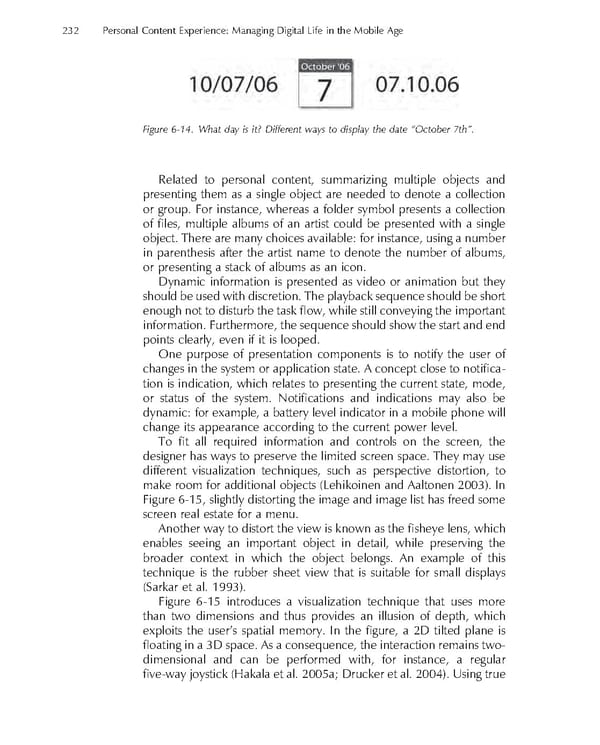
232 Personal Content Experience: Managing Digital Life in the Mobile Age Figure 6-14. What day is it? Different ways to display the date “October 7th”. Related to personal content, summarizing multiple objects and presenting them as a single object are needed to denote a collection or group. For instance, whereas a folder symbol presents a collection of fi les, multiple albums of an artist could be presented with a single object. There are many choices available: for instance, using a number in parenthesis after the artist name to denote the number of albums, or presenting a stack of albums as an icon. Dynamic information is presented as video or animation but they should be used with discretion. The playback sequence should be short enough not to disturb the task fl ow, while still conveying the important information. Furthermore, the sequence should show the start and end points clearly, even if it is looped. One purpose of presentation components is to notify the user of changes in the system or application state. A concept close to notifi ca- tion is indication, which relates to presenting the current state, mode, or status of the system. Notifi cations and indications may also be dynamic: for example, a battery level indicator in a mobile phone will change its appearance according to the current power level. To fi t all required information and controls on the screen, the designer has ways to preserve the limited screen space. They may use different visualization techniques, such as perspective distortion, to make room for additional objects (Lehikoinen and Aaltonen 2003). In Figure 6-15, slightly distorting the image and image list has freed some screen real estate for a menu. Another way to distort the view is known as the fi sheye lens, which enables seeing an important object in detail, while preserving the broader context in which the object belongs. An example of this technique is the rubber sheet view that is suitable for small displays (Sarkar et al. 1993). Figure 6-15 introduces a visualization technique that uses more than two dimensions and thus provides an illusion of depth, which exploits the user’s spatial memory. In the fi gure, a 2D tilted plane is fl oating in a 3D space. As a consequence, the interaction remains two- dimensional and can be performed with, for instance, a regular fi ve-way joystick (Hakala et al. 2005a; Drucker et al. 2004). Using true
 Personal Content Experience Page 255 Page 257