

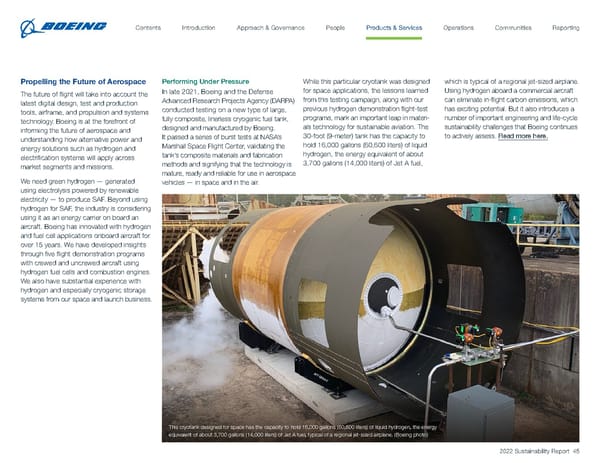
Propelling the Future of Aerospace The future of flight will take into account the latest digital design, test and production tools, airframe, and propulsion and systems technology. Boeing is at the forefront of informing the future of aerospace and understanding how alternative power and energy solutions such as hydrogen and electrification systems will apply across market segments and missions. We need green hydrogen — generated using electrolysis powered by renewable electricity — to produce SAF. Beyond using hydrogen for SAF, the industry is considering using it as an energy carrier on board an aircraft. Boeing has innovated with hydrogen and fuel cell applications onboard aircraft for over 15 years. We have developed insights through five flight demonstration programs with crewed and uncrewed aircraft using hydrogen fuel cells and combustion engines. We also have substantial experience with hydrogen and especially cryogenic storage systems from our space and launch business. Performing Under Pressure In late 2021, Boeing and the Defense Advanced Research Projects Agency (DARPA) conducted testing on a new type of large, fully composite, linerless cryogenic fuel tank, designed and manufactured by Boeing. It passed a series of burst tests at NASA’s Marshall Space Flight Center, validating the tank’s composite materials and fabrication methods and signifying that the technology is mature, ready and reliable for use in aerospace vehicles — in space and in the air. While this particular cryotank was designed for space applications, the lessons learned from this testing campaign, along with our previous hydrogen demonstration flight-test programs, mark an important leap in materi - als technology for sustainable aviation. The 30-foot (9-meter) tank has the capacity to hold 16,000 gallons (60,600 liters) of liquid hydrogen, the energy equivalent of about 3,700 gallons (14,000 liters) of Jet A fuel, which is typical of a regional jet-sized airplane. Using hydrogen aboard a commercial aircraft can eliminate in-flight carbon emissions, which has exciting potential. But it also introduces a number of important engineering and life-cycle sustainability challenges that Boeing continues to actively assess. Read more here. This cryotank designed for space has the capacity to hold This cryotank designed for space has the capacity to hold 16,000 gallons (60,600 liters) of liquid hydrogen, the energy equivalent of about 3,700 gallons (14,000 liters) of Jet A fuel, typical of a regional jet-sized airplane. (Boeing photo) 2022 Sustainability Report 45 Contents People Introduction Communities Operations Reporting Approach & Governance Products & Services
 The Boeing Company 2022 Sustainability Report Page 44 Page 46