

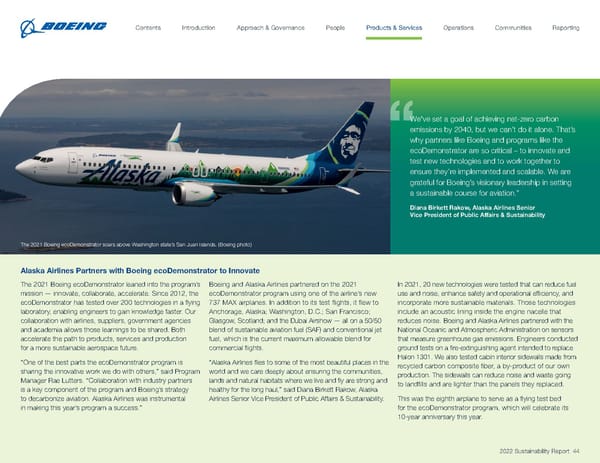
Alaska Airlines Partners with Boeing ecoDemonstrator to Innovate The 2021 Boeing ecoDemonstrator leaned into the program’s mission — innovate, collaborate, accelerate. Since 2012, the ecoDemonstrator has tested over 200 technologies in a flying laboratory, enabling engineers to gain knowledge faster. Our collaboration with airlines, suppliers, government agencies and academia allows those learnings to be shared. Both accelerate the path to products, services and production for a more sustainable aerospace future. “One of the best parts the ecoDemonstrator program is sharing the innovative work we do with others,” said Program Manager Rae Lutters. “Collaboration with industry partners is a key component of the program and Boeing’s strategy to decarbonize aviation. Alaska Airlines was instrumental in making this year’s program a success.” Boeing and Alaska Airlines partnered on the 2021 ecoDemonstrator program using one of the airline’s new 737 MAX airplanes. In addition to its test flights, it flew to Anchorage, Alaska; Washington, D.C.; San Francisco; Glasgow, Scotland; and the Dubai Airshow — all on a 50/50 blend of sustainable aviation fuel (SAF) and conventional jet fuel, which is the current maximum allowable blend for commercial flights. “Alaska Airlines flies to some of the most beautiful places in the world and we care deeply about ensuring the communities, lands and natural habitats where we live and fly are strong and healthy for the long haul,” said Diana Birkett Rakow, Alaska Airlines Senior Vice President of Public Affairs & Sustainability. In 2021, 20 new technologies were tested that can reduce fuel use and noise, enhance safety and operational efficiency, and incorporate more sustainable materials. Those technologies include an acoustic lining inside the engine nacelle that reduces noise. Boeing and Alaska Airlines partnered with the National Oceanic and Atmospheric Administration on sensors that measure greenhouse gas emissions. Engineers conducted ground tests on a fire-extinguishing agent intended to replace Halon 1301. We also tested cabin interior sidewalls made from recycled carbon composite fiber, a by-product of our own production. The sidewalls can reduce noise and waste going to landfills and are lighter than the panels they replaced. This was the eighth airplane to serve as a flying test bed for the ecoDemonstrator program, which will celebrate its 10-year anniversary this year. The 2021 Boeing ecoDemonstrator soars above Washington state’s San Juan Islands. (Boeing photo) We've set a goal of achieving net-zero carbon emissions by 2040, but we can’t do it alone. That’s why partners like Boeing and programs like the ecoDemonstrator are so critical – to innovate and test new technologies and to work together to ensure they’re implemented and scalable. We are grateful for Boeing’s visionary leadership in setting a sustainable course for aviation.” Diana Birkett Rakow, Alaska Airlines Senior Vice President of Public Affairs & Sustainability 2022 Sustainability Report 44 Contents People Introduction Communities Operations Reporting Approach & Governance Products & Services
 The Boeing Company 2022 Sustainability Report Page 43 Page 45