

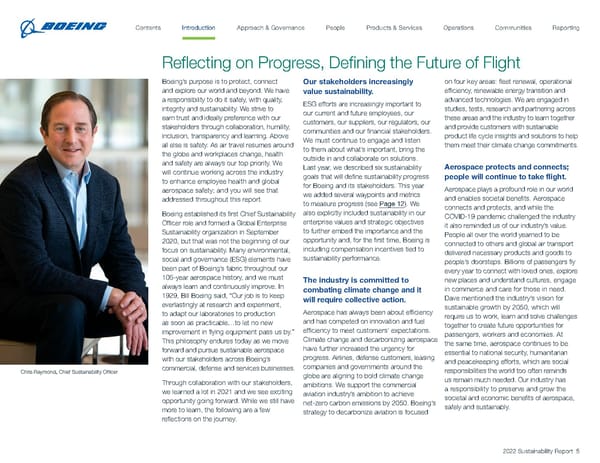
Reflecting on Progress, Defining the Future of Flight Boeing’s purpose is to protect, connect and explore our world and beyond. We have a responsibility to do it safely, with quality, integrity and sustainability. We strive to earn trust and ideally preference with our stakeholders through collaboration, humility, inclusion, transparency and learning. Above all else is safety. As air travel resumes around the globe and workplaces change, health and safety are always our top priority. We will continue working across the industry to enhance employee health and global aerospace safety; and you will see that addressed throughout this report. Boeing established its first Chief Sustainability Officer role and formed a Global Enterprise Sustainability organization in September 2020, but that was not the beginning of our focus on sustainability. Many environmental, social and governance (ESG) elements have been part of Boeing’s fabric throughout our 106-year aerospace history, and we must always learn and continuously improve. In 1929, Bill Boeing said, “Our job is to keep everlastingly at research and experiment, to adapt our laboratories to production as soon as practicable...to let no new improvement in flying equipment pass us by.” This philosophy endures today as we move forward and pursue sustainable aerospace with our stakeholders across Boeing’s commercial, defense and services businesses. Through collaboration with our stakeholders, we learned a lot in 2021 and we see exciting opportunity going forward. While we still have more to learn, the following are a few reflections on the journey. Our stakeholders increasingly value sustainability. ESG efforts are increasingly important to our current and future employees, our customers, our suppliers, our regulators, our communities and our financial stakeholders. We must continue to engage and listen to them about what’s important, bring the outside in and collaborate on solutions. Last year, we described six sustainability goals that will define sustainability progress for Boeing and its stakeholders. This year we added several waypoints and metrics to measure progress (see Page 12 ). We also explicitly included sustainability in our enterprise values and strategic objectives to further embed the importance and the opportunity and, for the first time, Boeing is including compensation incentives tied to sustainability performance. The industry is committed to combating climate change and it will require collective action. Aerospace has always been about efficiency and has competed on innovation and fuel efficiency to meet customers’ expectations. Climate change and decarbonizing aerospace have further increased the urgency for progress. Airlines, defense customers, leasing companies and governments around the globe are aligning to bold climate change ambitions. We support the commercial aviation industry’s ambition to achieve net-zero carbon emissions by 2050. Boeing’s strategy to decarbonize aviation is focused on four key areas: fleet renewal, operational efficiency, renewable energy transition and advanced technologies. We are engaged in studies, tests, research and partnering across these areas and the industry to learn together and provide customers with sustainable product life cycle insights and solutions to help them meet their climate change commitments. Aerospace protects and connects; people will continue to take flight. Aerospace plays a profound role in our world and enables societal benefits. Aerospace connects and protects, and while the COVID-19 pandemic challenged the industry it also reminded us of our industry’s value. People all over the world yearned to be connected to others and global air transport delivered necessary products and goods to people’s doorsteps. Billions of passengers fly every year to connect with loved ones, explore new places and understand cultures, engage in commerce and care for those in need. Dave mentioned the industry’s vision for sustainable growth by 2050, which will require us to work, learn and solve challenges together to create future opportunities for passengers, workers and economies. At the same time, aerospace continues to be essential to national security, humanitarian and peacekeeping efforts, which are social responsibilities the world too often reminds us remain much needed. Our industry has a responsibility to preserve and grow the societal and economic benefits of aerospace, safely and sustainably. Chris Raymond, Chief Sustainability Officer 2022 Sustainability Report 5 Contents People Introduction Communities Operations Reporting Approach & Governance Products & Services
 The Boeing Company 2022 Sustainability Report Page 4 Page 6