

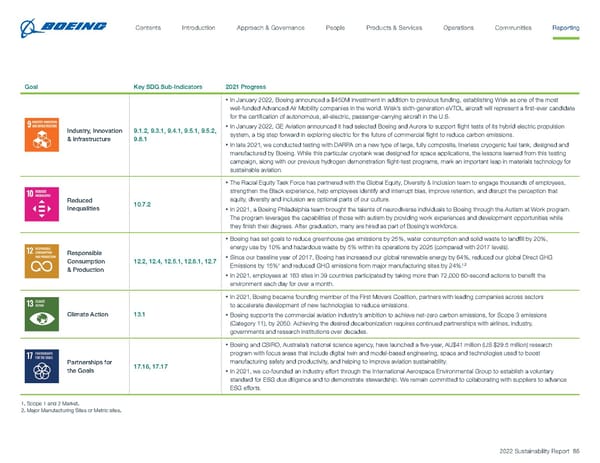
Goal Key SDG Sub-Indicators 2021 Progress Industry, Innovation & Infrastructure 9.1.2, 9.3.1, 9.4.1, 9.5.1, 9.5.2, 9.8.1 • In January 2022, Boeing announced a $450M investment in addition to previous funding, establishing Wisk as one of the most well-funded Advanced Air Mobility companies in the world. Wisk’s sixth-generation eVTOL aircraft will represent a first-ever candidate for the certification of autonomous, all-electric, passenger-carrying aircraft in the U.S. • In January 2022, GE Aviation announced it had selected Boeing and Aurora to support flight tests of its hybrid electric propulsion system, a big step forward in exploring electric for the future of commercial flight to reduce carbon emissions. • In late 2021, we conducted testing with DARPA on a new type of large, fully composite, linerless cryogenic fuel tank, designed and manufactured by Boeing. While this particular cryotank was designed for space applications, the lessons learned from this testing campaign, along with our previous hydrogen demonstration flight-test programs, mark an important leap in materials technology for sustainable aviation. Reduced Inequalities 10.7.2 • The Racial Equity Task Force has partnered with the Global Equity, Diversity & Inclusion team to engage thousands of employees, strengthen the Black experience, help employees identify and interrupt bias, improve retention, and disrupt the perception that equity, diversity and inclusion are optional parts of our culture. • In 2021, a Boeing Philadelphia team brought the talents of neurodiverse individuals to Boeing through the Autism at Work program. The program leverages the capabilities of those with autism by providing work experiences and development opportunities while they finish their degrees. After graduation, many are hired as part of Boeing’s workforce. Responsible Consumption & Production 12.2, 12.4, 12.5.1, 12.6.1, 12.7 • Boeing has set goals to reduce greenhouse gas emissions by 25%, water consumption and solid waste to landfill by 20%, energy use by 10% and hazardous waste by 5% within its operations by 2025 (compared with 2017 levels). • Since our baseline year of 2017, Boeing has increased our global renewable energy by 64%, reduced our global Direct GHG Emissions by 15% 1 and reduced GHG emissions from major manufacturing sites by 24%. 1,2 • In 2021, employees at 163 sites in 39 countries participated by taking more than 72,000 60-second actions to benefit the environment each day for over a month. Climate Action 13.1 • In 2021, Boeing became founding member of the First Movers Coalition, partners with leading companies across sectors to accelerate development of new technologies to reduce emissions. • Boeing supports the commercial aviation industry’s ambition to achieve net-zero carbon emissions, for Scope 3 emissions (Category 11), by 2050. Achieving the desired decarbonization requires continued partnerships with airlines, industry, governments and research institutions over decades. Partnerships for the Goals 17.16, 17.17 • Boeing and CSIRO, Australia’s national science agency, have launched a five-year, AU$41 million (US $29.5 million) research program with focus areas that include digital twin and model-based engineering, space and technologies used to boost manufacturing safety and productivity, and helping to improve aviation sustainability. • In 2021, we co-founded an industry effort through the International Aerospace Environmental Group to establish a voluntary standard for ESG due diligence and to demonstrate stewardship. We remain committed to collaborating with suppliers to advance ESG efforts. 1. Scope 1 and 2 Market. 2. Major Manufacturing Sites or Metric sites. 2022 Sustainability Report 86 Contents People Introduction Communities Operations Reporting Approach & Governance Products & Services
 The Boeing Company 2022 Sustainability Report Page 85 Page 87