

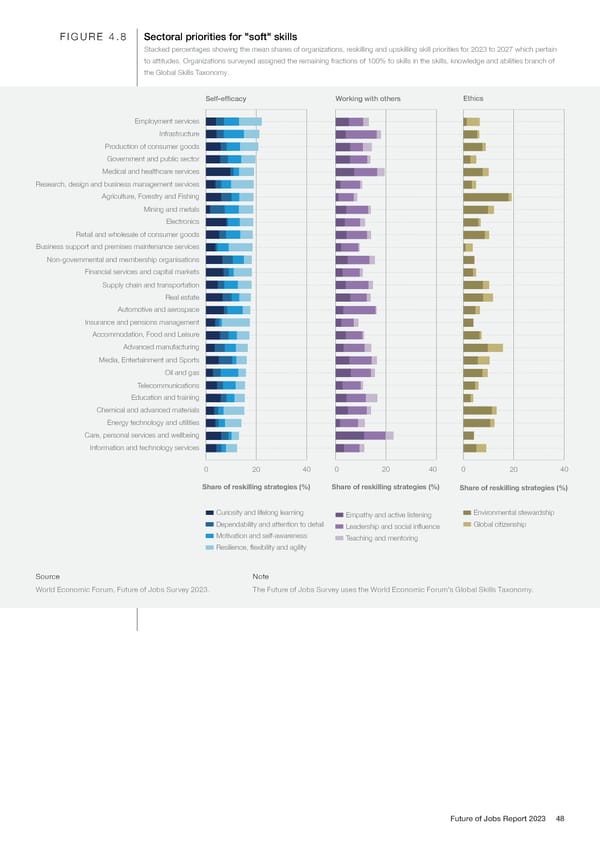
FIGURE 4.8 Sectoral priorities for "soft" skills Stacked percentages showing the mean shares of organizations, reskilling and upskilling skill priorities for 2023 to 2027 which pertain to attitudes. Organizations surveyed assigned the remaining fractions of 100% to skills in the skills, knowledge and abilities branch of the Global Skills Taxonomy. Self-efficacy Working with others Ethics Employment services Infrastructure Production of consumer goods Government and public sector Medical and healthcare services Research, design and business management services Agriculture, Forestry and Fishing Mining and metals Electronics Retail and wholesale of consumer goods Business support and premises maintenance services Non-governmental and membership organisations Financial services and capital markets Supply chain and transportation Real estate Automotive and aerospace Insurance and pensions management Accommodation, Food and Leisure Advanced manufacturing Media, Entertainment and Sports Oil and gas Telecommunications Education and training Chemical and advanced materials Energy technology and utilities Care, personal services and wellbeing Information and technology services 0 20 40 0 20 40 0 20 40 Share of reskilling strategies (%) Share of reskilling strategies (%) Share of reskilling strategies (%) Curiosity and lifelong learning Empathy and active listening Environmental stewardship Dependability and attention to detail Leadership and social influence Global citizenship Motivation and self-awareness Teaching and mentoring Resilience, flexibility and agility Source Note World Economic Forum, Future of Jobs Survey 2023. The Future of Jobs Survey uses the World Economic Forum's Global Skills Taxonomy. Future of Jobs Report 2023 48
 The Future of Jobs Report 2023 Page 47 Page 49