

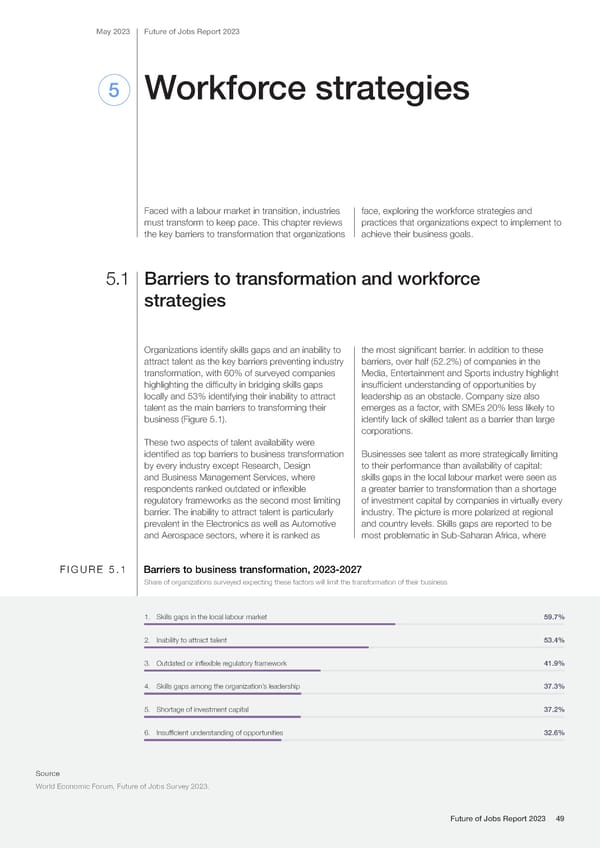
May 2023 Future of Jobs Report 2023 5 Workforce strategies Faced with a labour market in transition, industries face, exploring the workforce strategies and must transform to keep pace. This chapter reviews practices that organizations expect to implement to the key barriers to transformation that organizations achieve their business goals. 5.1 Barriers to transformation and workforce strategies Organizations identify skills gaps and an inability to the most significant barrier. In addition to these attract talent as the key barriers preventing industry barriers, over half (52.2%) of companies in the transformation, with 60% of surveyed companies Media, Entertainment and Sports industry highlight highlighting the difficulty in bridging skills gaps insufficient understanding of opportunities by locally and 53% identifying their inability to attract leadership as an obstacle. Company size also talent as the main barriers to transforming their emerges as a factor, with SMEs 20% less likely to business (Figure 5.1). identify lack of skilled talent as a barrier than large corporations. These two aspects of talent availability were identified as top barriers to business transformation Businesses see talent as more strategically limiting by every industry except Research, Design to their performance than availability of capital: and Business Management Services, where skills gaps in the local labour market were seen as respondents ranked outdated or inflexible a greater barrier to transformation than a shortage regulatory frameworks as the second most limiting of investment capital by companies in virtually every barrier. The inability to attract talent is particularly industry. The picture is more polarized at regional prevalent in the Electronics as well as Automotive and country levels. Skills gaps are reported to be and Aerospace sectors, where it is ranked as most problematic in Sub-Saharan Africa, where FIGURE 5.1 Barriers to business transformation, 2023-2027 Share of organizations surveyed expecting these factors will limit the transformation of their business 1. Skills gaps in the local labour market 59.7% 2. Inability to attract talent 53.4% 3. Outdated or inflexible regulatory framework 41.9% 4. Skills gaps among the organization’s leadership 37.3% 5. Shortage of investment capital 37.2% 6. Insufficient understanding of opportunities 32.6% Source World Economic Forum, Future of Jobs Survey 2023. Future of Jobs Report 2023 49
 The Future of Jobs Report 2023 Page 48 Page 50