

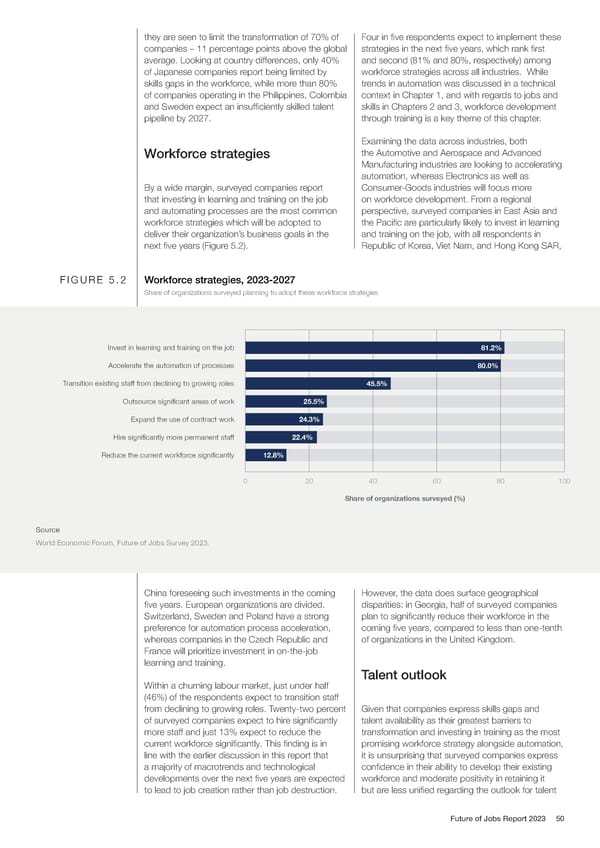
they are seen to limit the transformation of 70% of Four in five respondents expect to implement these companies – 11 percentage points above the global strategies in the next five years, which rank first average. Looking at country differences, only 40% and second (81% and 80%, respectively) among of Japanese companies report being limited by workforce strategies across all industries. While skills gaps in the workforce, while more than 80% trends in automation was discussed in a technical of companies operating in the Philippines, Colombia context in Chapter 1, and with regards to jobs and and Sweden expect an insufficiently skilled talent skills in Chapters 2 and 3, workforce development pipeline by 2027. through training is a key theme of this chapter. Examining the data across industries, both Workforce strategies the Automotive and Aerospace and Advanced Manufacturing industries are looking to accelerating automation, whereas Electronics as well as By a wide margin, surveyed companies report Consumer-Goods industries will focus more that investing in learning and training on the job on workforce development. From a regional and automating processes are the most common perspective, surveyed companies in East Asia and workforce strategies which will be adopted to the Pacific are particularly likely to invest in learning deliver their organization’s business goals in the and training on the job, with all respondents in next five years (Figure 5.2). Republic of Korea, Viet Nam, and Hong Kong SAR, FIGURE 5.2 Workforce strategies, 2023-2027 Share of organizations surveyed planning to adopt these workforce strategies Invest in learning and training on the job 81.2% Accelerate the automation of processes 80.0% Transition existing staff from declining to growing roles 45.5% Outsource significant areas of work 25.5% Expand the use of contract work 24.3% Hire significantly more permanent staff 22.4% Reduce the current workforce significantly 12.8% 0 20 40 60 80 100 Share of organizations surveyed (%) Source World Economic Forum, Future of Jobs Survey 2023. China foreseeing such investments in the coming However, the data does surface geographical five years. European organizations are divided. disparities: in Georgia, half of surveyed companies Switzerland, Sweden and Poland have a strong plan to significantly reduce their workforce in the preference for automation process acceleration, coming five years, compared to less than one-tenth whereas companies in the Czech Republic and of organizations in the United Kingdom. France will prioritize investment in on-the-job learning and training. Talent outlook Within a churning labour market, just under half (46%) of the respondents expect to transition staff from declining to growing roles. Twenty-two percent Given that companies express skills gaps and of surveyed companies expect to hire significantly talent availability as their greatest barriers to more staff and just 13% expect to reduce the transformation and investing in training as the most current workforce significantly. This finding is in promising workforce strategy alongside automation, line with the earlier discussion in this report that it is unsurprising that surveyed companies express a majority of macrotrends and technological confidence in their ability to develop their existing developments over the next five years are expected workforce and moderate positivity in retaining it to lead to job creation rather than job destruction. but are less unified regarding the outlook for talent Future of Jobs Report 2023 50
 The Future of Jobs Report 2023 Page 49 Page 51