

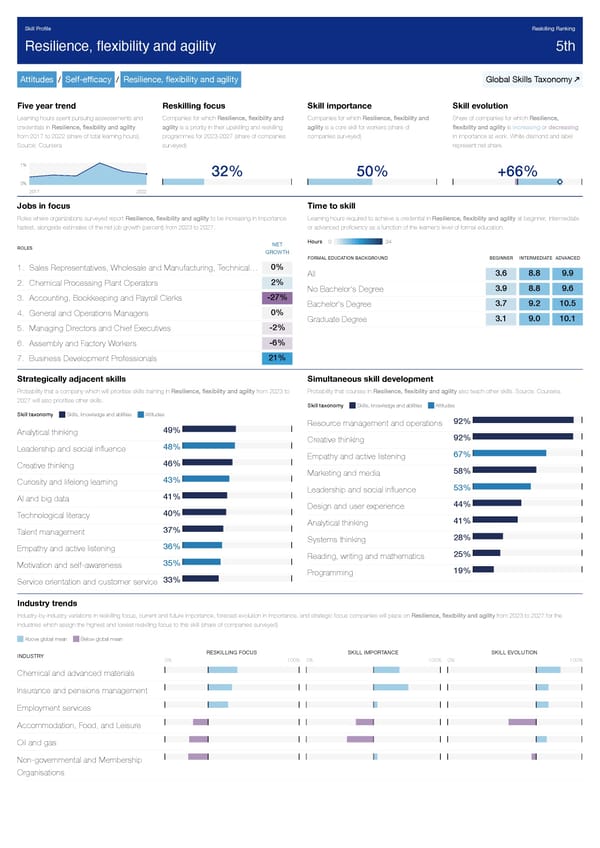
Skill Profile Reskilling Ranking Resilience, flexibility and agility 5th Attitudes Self-efficacy Resilience, flexibility and agility Global Skills Taxonomy / / Five year trend Reskilling focus Skill importance Skill evolution Learning hours spent pursuing assessements and Companies for which Resilience, flexibility and Companies for which Resilience, flexibility and Share of companies for which Resilience, credentials in Resilience, flexibility and agility agility is a priority in their upskilling and reskilling agility is a core skill for workers (share of flexibility and agility is increasing or decreasing from 2017 to 2022 (share of total learning hours). programmes for 2023-2027 (share of companies companies surveyed) in importance at work. White diamond and label Source: Coursera surveyed) represent net share. 1% 32% 50% +66% 0% 2017 2022 Jobs in focus Time to skill Roles where organizations surveyed report Resilience, flexibility and agility to be increasing in importance Learning hours required to achieve a credential in Resilience, flexibility and agility at beginner, intermediate fastest, alongside estimates of the net job growth (percent) from 2023 to 2027. or advanced proficiency as a function of the learner’s level of formal education. Hours 0 34 NET ROLES GROWTH FORMAL EDUCATION BACKGROUND BEGINNER INTERMEDIATE ADVANCED 0% 1. Sales Representatives, Wholesale and Manufacturing, Technical … 3.6 8.8 9.9 All 2% 2. Chemical Processing Plant Operators 3.9 8.8 9.6 No Bachelor's Degree -27% 3. Accounting, Bookkeeping and Payroll Clerks 3.7 9.2 10.5 Bachelor's Degree 0% 4. General and Operations Managers 3.1 9.0 10.1 Graduate Degree -2% 5. Managing Directors and Chief Executives -6% 6. Assembly and Factory Workers 21% 7. Business Development Professionals Strategically adjacent skills Simultaneous skill development Probability that a company which will prioritise skills training in Resilience, flexibility and agility from 2023 to Probability that courses in Resilience, flexibility and agility also teach other skills. Source: Coursera. 2027 will also prioritise other skills. Skill taxonomy Skills, knowledge and abilities Attitudes Skill taxonomy Skills, knowledge and abilities Attitudes 92% Resource management and operations 49% Analytical thinking 92% Creative thinking 48% Leadership and social influence 67% Empathy and active listening 46% Creative thinking 58% Marketing and media 43% Curiosity and lifelong learning 53% Leadership and social influence 41% AI and big data 44% Design and user experience 40% Technological literacy 41% Analytical thinking 37% Talent management 28% Systems thinking 36% Empathy and active listening 25% Reading, writing and mathematics 35% Motivation and self-awareness 19% Programming 33% Service orientation and customer service Industry trends Industry-by-industry variations in reskilling focus, current and future importance, forecast evolution in importance, and strategic focus companies will place on Resilience, flexibility and agility from 2023 to 2027 for the industries which assign the highest and lowest reskilling focus to this skill (share of companies surveyed) Above global mean Below global mean RESKILLING FOCUS SKILL IMPORTANCE SKILL EVOLUTION INDUSTRY 0% 100% 0% 100% 0% 100% Chemical and advanced materials Insurance and pensions management Employment services Accommodation, Food, and Leisure Oil and gas Non-governmental and Membership Organisations
 The Future of Jobs Report 2023 Page 264 Page 266