

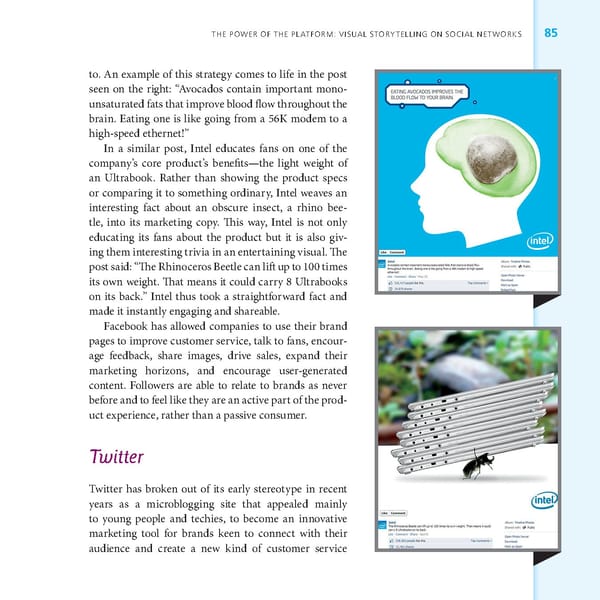
THE POWER OF THE PLATFORM: VISUAL STORYTELLING ON SOCIAL NETWORKS 85 to. An example of this strategy comes to life in the post seen on the right: “Avocados contain important mono- unsaturated fats that improve blood flow throughout the brain. Eating one is like going from a 56K modem to a high-speed ethernet!” In a similar post, Intel educates fans on one of the company’s core product’s benefits—the light weight of an Ultrabook. Rather than showing the product specs or comparing it to something ordinary, Intel weaves an interesting fact about an obscure insect, a rhino bee- tle, into its marketing copy. This way, Intel is not only educating its fans about the product but it is also giv- ing them interesting trivia in an entertaining visual. The post said: “The Rhinoceros Beetle can lift up to 100 times its own weight. That means it could carry 8 Ultrabooks on its back.” Intel thus took a straightforward fact and made it instantly engaging and shareable. Facebook has allowed companies to use their brand pages to improve customer service, talk to fans, encour- age feedback, share images, drive sales, expand their marketing horizons, and encourage user-generated content. Followers are able to relate to brands as never before and to feel like they are an active part of the prod- uct experience, rather than a passive consumer. Twitter Twitter has broken out of its early stereotype in recent years as a microblogging site that appealed mainly to young people and techies, to become an innovative marketing tool for brands keen to connect with their audience and create a new kind of customer service
 The Power of Visual Storytelling: How to Use Visuals, Videos, and Social Media to Market Your Brand Page 98 Page 100