

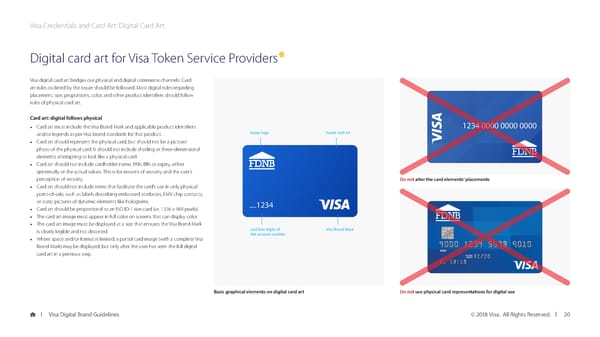
Visa Credentials and Card Art: Digital Card Art Digital card art for Visa Token Service Providers* Visa digital card art bridges our physical and digital commerce channels. Card art rules outlined by the issuer should be followed. Most digital rules regarding placement, size, proportions, color, and other product identifiers should follow rules of physical card art. Card art: digital follows physical • Card art must include the Visa Brand Mark and applicable product identifiers and/or legends as per Visa brand standards for that product. Issuer logo Issuer card art • Card art should represent the physical card, but should not be a picture/ photo of the physical card. It should not include shading or three-dimensional elements attempting to look like a physical card. • Card art should not include cardholder name, PAN, BIN or expiry, either generically or the actual values. This is for reasons of security and the user’s perception of security. Do not alter the card elements’ placements • Card art should not include items that facilitate the card’s use in only physical point-of-sale, such as labels describing embossed attributes, EMV chip contacts, or static pictures of dynamic elements like holograms. ....1234 • Card art should be proportional to an ISO ID-1 size card (i.e. 1536 x 969 pixels). • The card art image must appear in full color on screens that can display color. • The card art image must be displayed at a size that ensures the Visa Brand Mark is clearly legible and not distorted. Last four digits of Visa Brand Mark the account number • Where space and/or format is limited, a partial card image (with a complete Visa Brand Mark) may be displayed, but only after the user has seen the full digital card art in a previous step. Basic graphical elements on digital card art Do not use physical card representations for digital use Visa Digital Brand Guidelines © 2018 Visa. All Rights Reserved. 20
 Visa Brand Book Page 19 Page 21