

Deskbird 2023 | Whitepaper
The role of leadership in supporting and promoting a successful hybrid work model
The role of leadership in supporting and promoting a successful hybrid work model
Table of content I. Introduction II. The benefits of hybrid work for leadership A. Increased flexibility and adaptability B. Improved communication and collaboration C. Greater diversity and inclusion D. Enhanced creativity and innovation leadership III. The challenges of hybrid work for A. Difficulty managing remote teams B. Difficulty maintaining culture and engagement C. Difficulty fostering trust and accountability D. Difficulty providing equitable opportunities and support hybrid work environment IV. Strategies for effective leadership in a A. Setting clear expectations and goals B. P rioriti z ing communication and connection C. F ostering a culture of trust and accountability D. Establishing an agile and flexible organi z ational structure V. C onclusion 02 T he role of leadership in supporting and promoting a successful hybrid w or k model
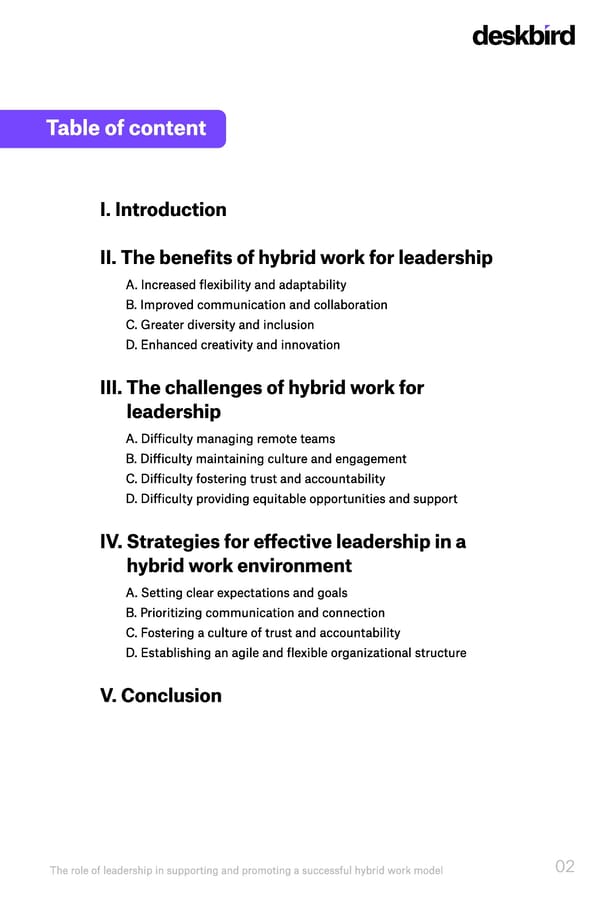
I 03 Introduction A. What’s hybrid work? B. Importance of leadership in a hybrid work environment The role of leadership in supporting and promoting a successful hybrid work model 1 For more info, read Working Hybrid | Why it is the Future of Work | deskbird Hybrid work combines in-person and remote work, allowing employees to experience both. It provides the benefits of both in- person collaboration and deep at-home focus. Hybrid work looks different at every company. At some, there are fixed hybrid schedules that require employees to come into the office on specific days. At others, employees have the freedom to choose when to work from home. Some companies even have global teams with hubs in major cities, meaning employees may only interact with international co-workers once or twice a year. Regardless of how hybrid is implemented, it provides a host of benefits for the business – like improved work-life balance, greater productivity, and increased employee satisfaction and retention1. As more businesses embrace flexible work models, the responsibility falls on leadership to implement these models properly. One challenge that arises is coordinating employees, their schedules, and their working locations. Ensuring efficiency and collaboration can be difficult with employees working from different places or time zones. Why is this so important? Our research has shown that coordinated hybrid work increases productivity by 20% on average per week. Leadership drives the success of hybrid companies, from providing coordination to ensuring individual employees feel satisfied in their roles.
II 04 The benefits of hybrid work for leadership A. Increased flexibility and adaptability B. Improved communication and collaboration The role of leadership in supporting and promoting a successful hybrid work model 2 On flexibility, see How to Manage Remote Teams? 14 Best Practices | deskbird 3 See Women in the Hybrid Workplace: Attracting & Retaining Female Leaders | Deadline News The benefits hybrid work provides employees are discussed often, but what about its benefits for those in leadership positions? Leaders and employees alike reap the benefits of greater flexibility at work. In a hybrid organization, leaders have greater flexibility2. This means they can work from anywhere or at different times of the day. In traditional organizations, this freedom is not usually granted to those in leadership positions, as they often have to be physically present for important meetings with stakeholders or employees. But leaders can benefit from flexibility because it provides them with more work-life balance. Additionally, this gives way to opportunities for female leaders to further their careers, which may have otherwise been stifled by personal responsibilities at home. Now, we are seeing female leaders do both, increasing the representation of women in the workplace3. In remote-only environments, communication and collaboration might suffer, and mediated interaction becomes the primary way leaders engage with their teams. M eaning can get lost through text- only messages, and human connection can be hindered when only communicating through video calls.
05 C. Greater diversity and inclusion D. Enhanced creativity and innovation The role of leadership in supporting and promoting a successful hybrid work model 4 On the benefits of Diversity & Inclusion, see What are the benefits of diversity in the workplace? | deskbird 5 See How are Employee Happiness and Productivity linked? | deskbird But, with hybrid models, leaders have the opportunity to connect and collaborate with their teams in person when necessary. Projects needing in-person discussion because they are timely or require synchronous communication can occur in the office. Flexible models cater to diversity and inclusion because they scrap the bounds of time and location. In other words, hybrid and remote companies can recruit employees and leaders from around the world, regardless of where they live or which time zone they are working in. This benefits leaders in two ways. First, this gives those with leadership potential opportunities to work at companies that they otherwise would not have been able to. As previously mentioned, it gives way to more female leaders who might need to work from home to nurture their children. Second, more diverse teams are more creative and productive. Different backgrounds breed greater perspectives and, in turn, more fruitful problem-solving, and idea-generation. Piggy-backing off of our previous point, hybrid teams are more creative and innovative5 not only because they are diverse but also because they have better work-life balance and are more satisfied. W hile remote-only environments don ’ t provide opportunities for in- person collaboration, hybrid models do. This not only means teams benefit from in-the-zone productivity while at home without distraction, but it also means teams can use their time in person to bounce ideas off of each other as well.
III 06 The challenges of hybrid work for leadership The role of leadership in supporting and promoting a successful hybrid work model 6 Tips and best practices Culture of the Workplace: A Complete Guide for Companies | deskbird While flexible models provide increased satisfaction and productivity, they can be challenging to implement and manage. This is especially true for global teams in different locations and time zones. A. Difficulty managing remote teams Remote teams can be difficult to manage for a number of reasons.— Ÿ First, coordinating a distributed team across multiple locations and time zones can be challenging. Meetings that occur both in-person and remotely need to be timed and organized so everyone can attend. Ÿ Secondly, remote teams need leaders who know each employee's schedule and location to ensure that tasks that are best completed in person or with additional collaboration are provided with the physical space needed. Ÿ Third, communication within remote teams is often asynchronous, meaning leaders need to wait for each individual to respond to messages, emails, and requests rather than telling them in person and getting instant feedback. B. Difficulty maintaining culture and engagement I n remote environments, culture and engagement can be difficult to maintain as these two aspects are highly dependent on in-person interaction. C ulture is developed as employees interact with one another. So as this interaction decreases, the ability to sustain a company culture tends to decrease with it. Similarly, employees might feel isolated at home, and in turn, their engagement can suffer. B ut, hybrid work helps tackle these issues by giving teams the time and space to interact in person.6
07 The role of leadership in supporting and promoting a successful hybrid work model C. Difficulty fostering trust and accountability While we have seen increased productivity among employees working from home, some leaders still struggle to believe this is possible. They are guided by the bias that if they cannot see tasks being completed, then they are not being done. Therefore, hybrid team leaders must overcome this and develop trust and accountability with their colleagues. D. Difficulty providing equitable opportunities and support Hybrid and remote work can exacerbate the existing imbalances between men and women in the workplace. On the one hand, working from home gives women the ability to raise their children while also working. On the other hand, studies have shown that those who are physically present in the workplace are more likely to get promoted. Therefore, the opportunity for career advancement differs among those who work from home versus those who work in the office. So while remote work allows more people to work while also managing other expectations, it tends to serve those who also come into the office.
08 The role of leadership in supporting and promoting a successful hybrid work model IV Strategies for effective leadership in a hybrid work environment While flexible models provide increased satisfaction and productivity, they can be challenging to implement and manage. This is especially true for global teams in different locations and time zones. A. Setting clear expectations and goals B. Prioritizing communication and connection Since leaders in hybrid settings don’t see their team daily, it is important to set clear goals and expectations about everything from task completion to when each employee is expected to be in the office. Synchronous communication can be difficult in remote settings, so managing expectations from the get-go ensures that everyone is on the same page rather than having to clarify constantly. Additionally, expectations surrounding when each individual is expected to be in the office allow leaders to plan collaboration and manage which tasks need to be done in person. The greater the flexibility, the more managers need to set clear expectations. With clear goals set, employees can be evaluated based on their achievement of these goals rather than on how much they physically work. Similar to the reasons mentioned above, leaders should prioritize communication. To prevent misunderstandings regarding professional achievement and personal interactions, leaders need to create an open environment for their team to communicate freely and honestly.
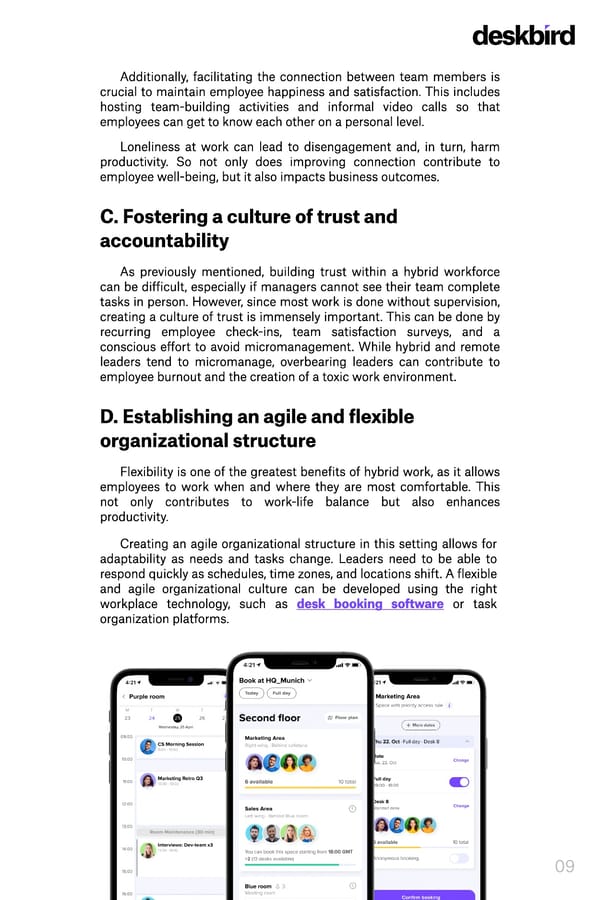
09 C. Fostering a culture of trust and accountability D. Establishing an agile and flexible organizational structure Additionally, facilitating the connection between team members is crucial to maintain employee happiness and satisfaction. This includes hosting team-building activities and informal video calls so that employees can get to know each other on a personal level. Loneliness at work can lead to disengagement and, in turn, harm productivity. So not only does improving connection contribute to employee well-being, but it also impacts business outcomes. As previously mentioned, building trust within a hybrid workforce can be difficult, especially if managers cannot see their team complete tasks in person. However, since most work is done without supervision, creating a culture of trust is immensely important. This can be done by recurring employee check-ins, team satisfaction surveys, and a conscious effort to avoid micromanagement. While hybrid and remote leaders tend to micromanage, overbearing leaders can contribute to employee burnout and the creation of a toxic work environment. Flexibility is one of the greatest benefits of hybrid work, as it allows employees to work when and where they are most comfortable. This not only contributes to work-life balance but also enhances productivity. Creating an agile organizational structure in this setting allows for adaptability as needs and tasks change. Leaders need to be able to respond quickly as schedules, time zones, and locations shift. A flexible and agile organizational culture can be developed using the right workplace technology, such as or task organization platforms. desk booking software
10 IV Conclusion Hybrid work is quickly becoming one of the most prominent work models, allowing employees to connect in person while providing the flexibility many of us enjoy while working from home. However, one of the key drivers of success for this model is the right leadership. Leaders must implement the right strategies to overcome challenges like maintaining culture and developing trust. They need to set clear goals, prioritize communication, and establish an agile organizational structure. Only then will the many benefits of hybrid work, like enhancing creativity and improvements in efficiency, come to fruition. Leaders must embrace the opportunities and challenges of hybrid work to lead effectively. Changing work structures that are deeply ingrained in workplace culture and fulfilling evolving expectations of the workforce is not easy. But with the right tools and strategies, leaders can effectively manage their hybrid teams. Sources Hybrid Work Model and Hybrid Leaders - Leadership (iil.com) Rethinking Leadership In A Hybrid Work Model (forbes.com) Leadership Development in a Hybrid Work Model - SightsIn Plus Hybrid leadership: 13 best practices to future-proof the office - OfficeSpace Software Seven leadership approaches for a hybrid working world | HRZone Tips for Effective Leadership in a Hybrid Work Model | Inc.com
Click, Book, Work Start for free